
By Dr. Ramesh Kumar, MD Board-Certified Radiation Oncologist & Functional Medicine Expert Founder, LifeWell MD
Last Updated: December 28th 2025 | Reading Time: 8 Minutes
at a Glance: Key Takeaways
- What it is: BPC 157 is a synthetic peptide derived from gastric juice, known for its potential to accelerate tissue healing and gut repair.
- The Evidence: Animal studies are robust and positive; human data is currently limited to three small studies.
- FDA Status: As of 2025, BPC 157 Peptide is a Category 2 bulk drug substance and cannot be legally compounded for human use.
- Safety Profile: While generally well-tolerated in limited trials, theoretical concerns exist regarding angiogenesis and tumor growth.
- The Bottom Line: Proceed with extreme caution. Quality control in the “research chemical” market is a major risk.
Last month, three patients asked me the same question within a single week: “Doc, what do you think about BPC-157?”
The first was a 52-year-old executive with chronic shoulder pain who had tried everything. The second was a marathon runner whose Achilles tendon simply wouldn’t heal. The third was a businessman whose gut health issues were destroying his quality of life.
All three had heard about this peptide online. All three were confused by the wildly conflicting information—some sources calling it a “miracle cure,” others warning it could cause cancer.
As a Harvard-trained physician with over 30 years in medicine—including decades treating cancer patients before transitioning to integrative medicine—I find myself in a unique position. I understand the biohacking enthusiasm, but I also respect the rigorous skepticism of oncology.
Patients deserve a nuanced conversation, not influencer hype. Here is the honest medical assessment of BPC-157 for 2025.
What Is BPC-157?
BPC 157 stands for Body Protection Compound-157. It is a synthetic peptide composed of 15 amino acids, derived from a protein naturally found in human gastric juice.
Croatian researchers discovered it in the 1990s while studying the stomach’s ability to protect and repair itself. The peptide earned its name because, in laboratory settings, it appeared to:
- Protect organ tissues from damage.
- Accelerate the healing of wounds.
- Reduce inflammation rapidly.
BPC 157 Peptide Benefits: What the Research Actually Shows
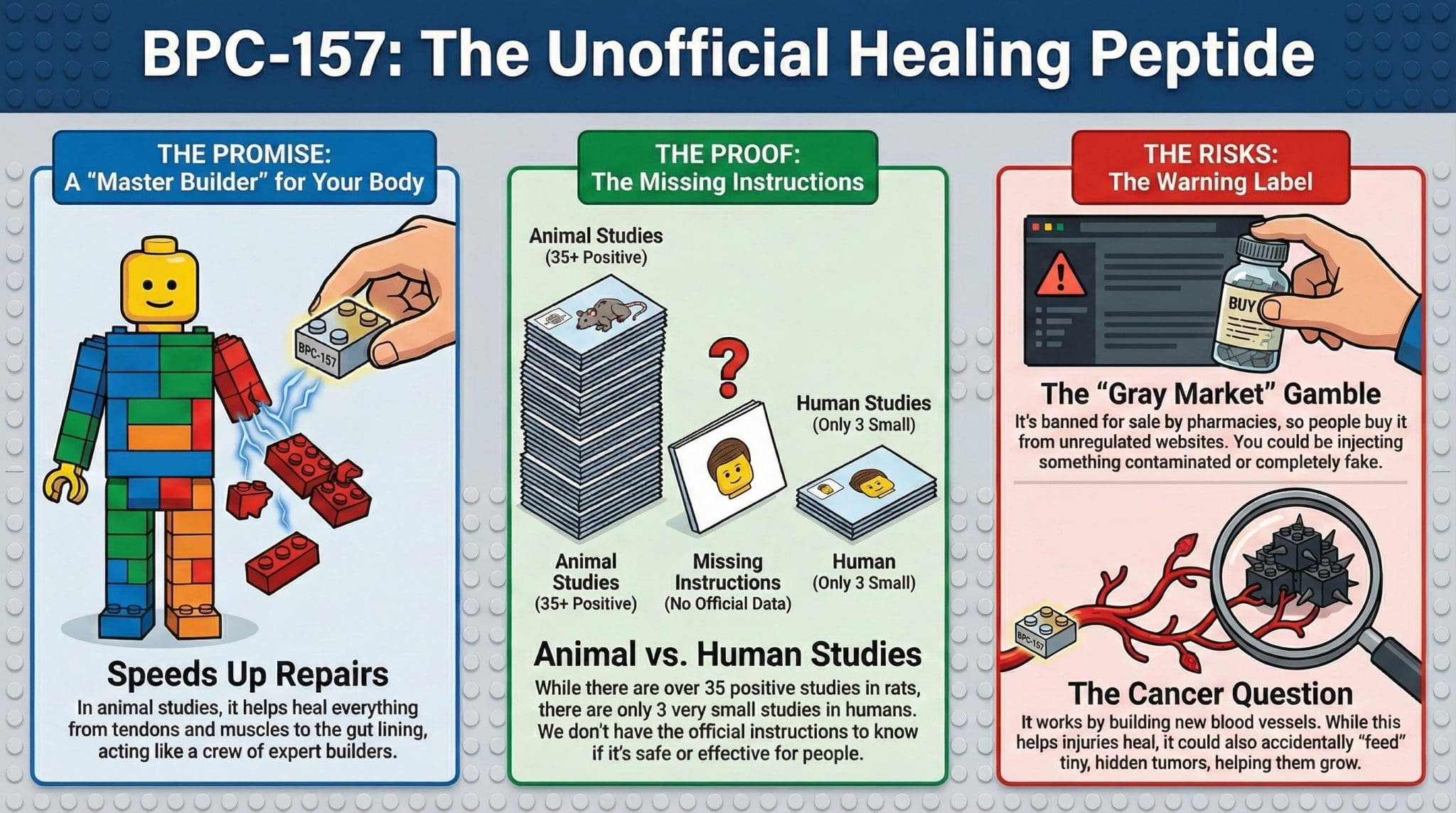
As you can see in the graphic above, there is a massive discrepancy between the animal data we have and the human data we need…
To be a beacon of truth, I must be transparent about the gap between animal data and human data.
The Animal Evidence (Promising)
Since 1993, researchers have published over 35 studies on rodent models. These preclinical trials have demonstrated:
- Tendon & Ligament Healing: Accelerated repair of Achilles tendon injuries.
- Gut Health: Enhanced repair of the gut mucosa (lining) and reduction of inflammation in models of IBD.
- Neuroprotection: Potential protective effects on the nervous system.
The Human Evidence (Thin)
This is where the “miracle cure” narrative hits a wall. To date, we have roughly 30 patients total across three small human studies:
- Knee Pain (2021): A case series of 12 people; 7 reported relief lasting 6+ months.
- Interstitial Cystitis (2024): A pilot study of 12 women; 83% reported symptom improvement.
- Safety Study (2025): IV BPC-157 given to two healthy adults; found to be well-tolerated.
The Verdict: The animal data is intriguing, but the human data is still in its infancy. It is not yet robust enough for standard medical recommendation.
Why Is BPC 157 Controversial? (FDA & WADA Status)
The disconnect between patient interest and medical acceptance comes down to regulation and safety data.
Why the FDA Restricted BPC-157 Peptide:
In 2023, the FDA classified BPC-157 as a Category 2 bulk drug substance.
- What this means: Licensed compounding pharmacies cannot legally create BPC-157 medications for human use.
- The reasoning: The FDA cited “insufficient evidence” of safety/efficacy and potential risks related to immunogenicity (immune reactions).
WADA & Athletes
The World Anti-Doping Agency (WADA) lists BPC-157 as an S0 Unapproved Substance. It is banned in and out of competition. There is no “Therapeutic Use Exemption” (TUE) available for it.
Does BPC-157 Cause Cancer? An Oncologist’s Perspective
This section is critical. As a Radiation Oncologist who has treated over 10,000 cancer patients, I approach this question with extreme care.
The Mechanism: Angiogenesis
BPC-157 works partly by promoting angiogenesis—the formation of new blood vessels.
- The Good: Injured tissue needs new blood supply to heal.
- The Bad: Tumors also need new blood supply to grow and spread (metastasize).
The Theoretical Risk
The fear is that by taking a compound that boosts blood vessel growth, you could inadvertently “feed” dormant cancer cells or micro-tumors that you don’t know exist.
What We Know
- VEGFR2 Pathway: Studies show BPC-157 upregulates the VEGFR2 pathway, which is active in about 50% of human cancers.
- Conflicting Data: Paradoxically, some preclinical studies suggest BPC-157 might inhibit certain tumor cell lines or reduce cancer-related muscle wasting (cachexia).
My Medical Opinion: There is no direct evidence that BPC-157 causes cancer in humans. However, the theoretical risk is plausible.
Warning: I would not recommend BPC-157 for anyone with an active malignancy, a recent history of cancer, or a strong family history of cancer.
Routes of Administration & Dosage
Note: There is no FDA-approved dosage. The following are based on anecdotal reports and research protocols.
- Subcutaneous Injection: Considered the “gold standard” for absorption. Typically injected near the injury site or systemically.
- Oral BPC-157: Preferred for gut health issues (e.g., IBS, leaky gut). BPC-157 is stable in gastric juice, making it unique among peptides.
- Intranasal: Sometimes used for neurological applications (brain fog, neuro-inflammation).
The Hidden Danger: The “Gray Market” Crisis
If you decide to use BPC-157, your biggest risk might not be the peptide itself—it might be the supplier.
Because FDA-regulated pharmacies cannot compound it, users are forced to buy from “research chemical” websites. These products are:
- Unregulated: No oversight on purity or potency.
- Contaminated: Analyses have found endotoxins, heavy metals, and wrong dosages in online peptide vials.
- Mislabelled: You simply do not know what is in the vial.
Injecting a substance of unknown purity into your body is a gamble no responsible physician can endorse.
Effective Alternatives to BPC-157
If you are looking for healing but want to stay within the realm of proven, regulated medicine, consider these alternatives available at LifeWell MD:
1. For Tissue & Joint Healing
- Platelet-Rich Plasma (PRP): Uses your own blood’s growth factors to stimulate healing. High safety profile.
- Prolotherapy: A regenerative injection technique with decades of clinical data.
- Shockwave Therapy: Excellent for soft tissue injuries and blood flow.
2. For Gut Health
- Functional Gut Protocols: We use advanced testing to identify dysbiosis or food sensitivities.
- L-Glutamine & Peptide Therapy: Safe, oral supplements that support the intestinal lining.
- Medical Acupuncture: To regulate GI motility and reduce inflammation.
Common Side Effects of BPC-157 Peptide
What are the known side effects of BPC-157? Because human clinical trials are so limited, a complete medical list of BPC 157 peptide side effects has not been fully established. However, based on the FDA’s review and available data, potential risks include:
-
Immunogenicity: The FDA has raised concerns that the body may recognize the peptide as a foreign invader, potentially triggering abnormal immune system reactions.
-
Injection Site Reactions: Pain, redness, or fibrosis (hardening) at the injection area.
-
Digestive Upset: Oral users occasionally report nausea or bloating.
-
Toxicity from Contamination: The most severe “side effects” often come not from the peptide itself, but from endotoxins and heavy metals found in unregulated “research grade” vials.
Does BPC-157 cause high blood pressure? BPC-157 interacts with the nitric oxide system, which regulates blood pressure. While some anecdotal logs suggest it may stabilize blood pressure, there are reports of temporary fluctuations (spikes or drops) immediately after administration.
Are there long-term dangers? The primary long-term concern is proliferative retinopathy or tumor growth (cancer). Since BPC-157 promotes the growth of new blood vessels (angiogenesis), there is a theoretical risk that it could worsen conditions driven by abnormal blood vessel growth.
Final Verdict: Should You Use BPC-157?
After reviewing the evidence and counseling patients, here is my stance:
- It is promising. The animal data is consistent and the mechanism makes sense.
- It is unproven. We lack the human safety trials to be sure.
- It carries risk. Especially regarding cancer history and product purity.
My Advice: Do not make this decision based on a podcast. If you are struggling with a chronic injury or gut issue, let’s look at the whole picture—inflammation, hormones, and mechanics—before jumping to unregulated compounds.
Ready for a Science-Based Approach to Healing?
At LifeWell MD, we combine the best of modern technology with the wisdom of functional medicine. We serve patients in North Palm Beach and Port St. Lucie, Florida, as well as virtually.
Schedule a Consultation with Dr. Kumar Don’t guess with your health. Get a personalized roadmap from a Board-Certified expert.
Please check out his 120 five star reviews on Healthgrades and his 136 five star reviews at WebMD.. You can also see more LifeWell MD reviews.
Follow Dr. Kumar on his substack account for frequent updates on this and other topics.
Frequently Asked Questions (FAQ)
Is BPC-157 legal in the US? BPC-157 is legal to possess (it is not a controlled substance). However, the FDA prohibits pharmacies from compounding it for human use, so it cannot be legally sold as a medication/supplement for humans.
How long does it take for BPC-157 to work? Users often report acute pain relief in 7–14 days. Chronic tendon or gut issues may require 4–6 weeks of protocol.
Can BPC-157 be combined with TB-500? Many “biohackers” stack BPC-157 with TB-500 (Thymosin Beta-4) for synergistic healing effects. While popular, no human safety data exists for this specific combination.
Does BPC-157 show up on drug tests? Standard workplace drug tests do not screen for BPC-157. However, it is banned by WADA, and specialized sports doping tests can detect it.
Serving North Palm Beach & The Treasure Coast
LifeWell MD is a premier integrative medicine practice founded by Dr. Ramesh Kumar. We are dedicated to bringing world-class Men’s Health and Functional Medicine expertise to Florida’s East Coast.
We proudly serve patients across the following regions:
-
North Palm Beach: Conveniently located for residents of Palm Beach Gardens, Jupiter, Juno Beach, and West Palm Beach.
-
The Treasure Coast: Our Port St. Lucie location serves patients from Stuart, Jensen Beach, Fort Pierce, and Vero Beach.
Whether you are looking for a second opinion on a complex health issue or a proactive plan for longevity, our two clinic locations ensure that expert, physician-led care is always within reach.
North Palm Beach Location
Port St. Lucie Location
Medical Disclaimer: This article is for educational purposes only and does not constitute medical advice. BPC-157 is not FDA-approved. Always consult with a qualified healthcare provider before pursuing any peptide therapy.
