
By Dr. Ramesh Kumar, MD, exploring the differences between BPC-157 vs TB-500.
Board-Certified Radiation Oncologist | Functional Medicine Expert
Founder, LifeWell MD – North Palm Beach & Port St. Lucie, FL
Last Updated: December 2025 | Reading Time: 12 Minutes
Introduction
This article provides an honest and detailed comparison of the peptides BPC-157 and TB-500, commonly combined as the “Wolverine Stack.” It explores their mechanisms, potential benefits, associated risks—especially for men over 40—and safer alternative therapies available. Designed for men interested in injury recovery and performance enhancement, this review highlights why understanding these peptides is crucial amid their growing popularity and mounting safety concerns.
Executive Summary: The “Busy Professional” Version
- The Trend: Men are “stacking” BPC-157 and TB-500 to accelerate injury recovery, famously called the “Wolverine Stack.”
- The Mechanism: BPC-157 builds new blood vessels (angiogenesis), while TB-500 promotes cell migration (movement).
- The Oncologist’s Warning: While BPC-157 has a theoretical risk of feeding tumors, TB-500 (Thymosin Beta-4) has a documented role in cancer metastasis (spreading). This is a critical risk distinction for men over 40.
- The Legal Status: Both are classified as unregulated research chemicals or bulk drug substances restricted by the FDA.
- The Better Path: For men in North Palm Beach and the Treasure Coast, we use safer, regulated alternatives like PRP, hormone optimization, and targeted regenerative therapies that don’t carry the same cancer risks.
Part 1: Understanding the Players
To make an informed decision, we must strip away the bro-science and look at the biochemistry.
The Builder: BPC-157 Peptide
As I discussed in my previous deep dive on BPC-157, this peptide is derived from human gastric juice.
- Primary Action: Angiogenesis (forming new blood vessels).
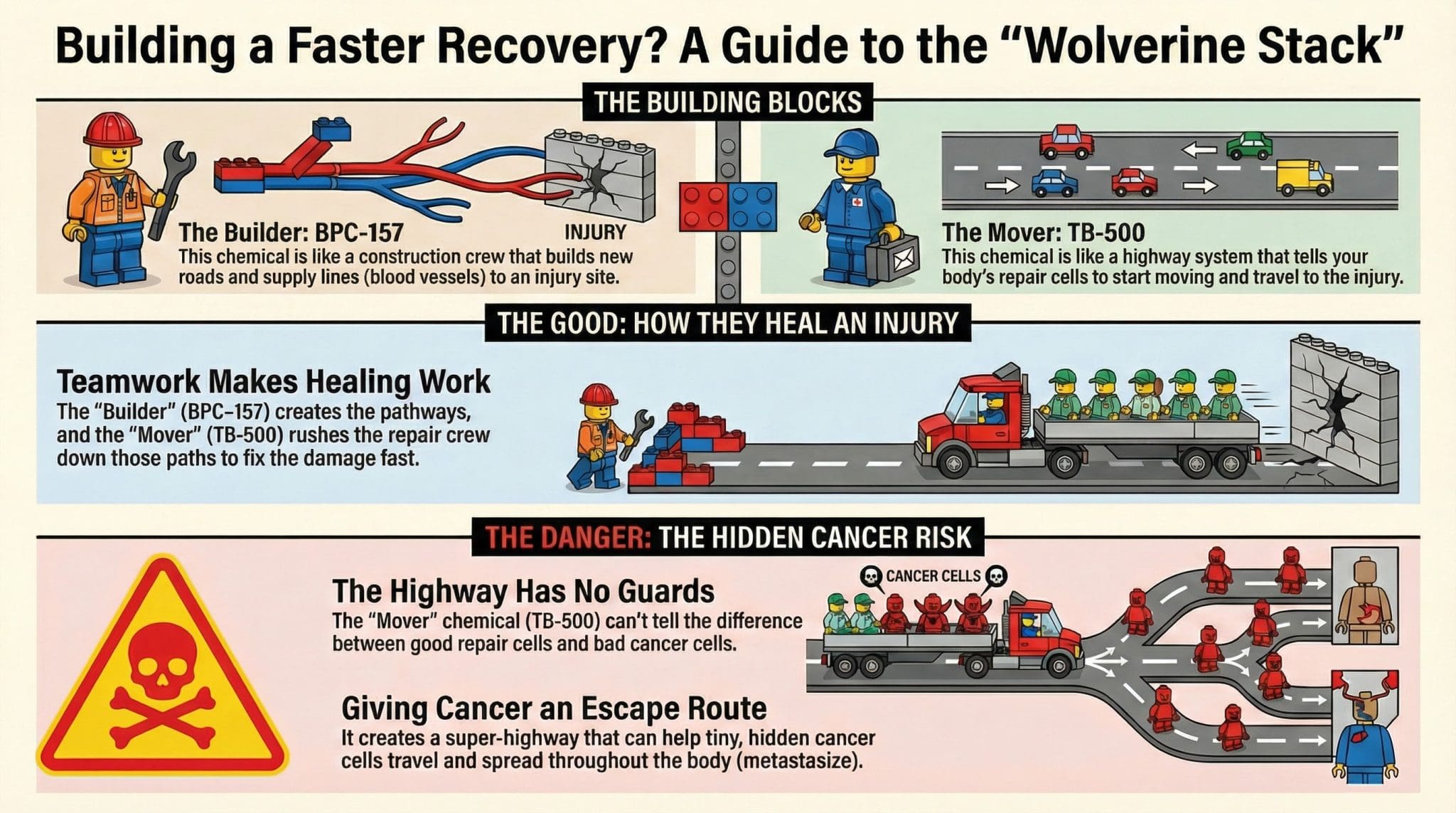
- The Analogy: Think of BPC-157 as the Construction Crew. It arrives at the job site (injury) and lays down the infrastructure (blood vessels) needed to bring supplies.
The Mover: TB-500 Peptide (Thymosin Beta-4)
TB-500 is a synthetic fragment of the naturally occurring protein Thymosin Beta-4 (Tβ4).
- Primary Action: Actin sequestration and cell migration.
- The Science: Every cell in your body has a “skeleton” made of actin. TB-500 helps reorganize this skeleton, allowing cells to become mobile and move effectively.
- The Analogy: If BPC-157 is the construction crew, TB-500 is the Highway System. It clears the traffic and allows repair cells to travel from surrounding tissues into the injury site rapidly.
Why They Are Stacked
The synergy is theoretically brilliant. You use BPC-157 to build the supply lines and TB-500 to rush the workers to the site. In animal models, this combination has shown remarkable efficacy in healing muscle tears, ligament strain, and even cardiac tissue damage.
But humans are not lab rats. And humans—especially men over 40—have a very specific risk factor that rats in short-term studies do not: Dormant Cancer.

Part 2: The Oncologist’s Warning (The Metastasis Risk)
This is the most important section of this article. Please read it carefully.
In the biohacking world, safety is often defined as “did I feel sick immediately after taking it?” In medicine, safety is defined as “did this increase my risk of dying 10 years from now?”
The TB-500 Paradox
Thymosin Beta-4 (the protein TB-500 mimics) is essential for life. It helps form your heart and organs when you are an embryo. However, in adulthood, high levels of Tβ4 are often found in one specific place: Aggressive Tumors.
Why? Because cancer cells are smart.
To kill you, a solid tumor (like prostate or colon cancer) usually needs to do two things:
- Feed itself: It needs blood vessels (Angiogenesis).
- Spread: It needs to break away and travel to the lungs, liver, or bones (Metastasis).
Connecting the Dots
- BPC-157 promotes Angiogenesis (Step 1).
- TB-500 promotes Cell Migration (Step 2).
When we treat cancer, we often use drugs specifically designed to stop cell migration. When you inject TB-500, you are flooding your system with a signal that tells cells: “It’s time to move.”
If you have a microscopic, undiagnosed cluster of prostate cancer cells—which autopsy studies suggest nearly 30% of men over 50 do—you do not want to give them a roadmap and a green light to migrate.
Dr. Kumar’s Verdict:
“I am cautious about BPC-157 due to angiogenesis risks. But I am highly restrictive with TB-500. The mechanism of action—upregulating cell migration—mimics the exact pathway cancer cells use to metastasize. For a healthy 20-year-old athlete, the risk is low. For a 50-year-old man, the risk-benefit analysis shifts dramatically.”
Part 3: Comparison – BPC-157 vs. TB-500
To help Google (and you) process the differences, I’ve broken them down into this functional comparison table.
| Feature | BPC-157 | TB-500 (Thymosin Beta-4) |
| Primary Role | Healing gut lining, tendons, & ligaments. | Muscle recovery, flexibility, & inflammation. |
| Mechanism | Angiogenesis: Builds new blood vessels. | Cell Migration: Helps cells move to injury. |
| Best For | “Pest” injuries: nagging tendonitis, gut issues. | “Trauma” injuries: muscle tears, strains. |
| Cancer Risk | Theoretical (Feeding tumor growth). | Elevated Concern (Promoting metastasis/spread). |
| Dosing Schedule | Daily (Short half-life of ~4 hours). | 2x Weekly (Longer half-life of ~2-3 days). |
| Systemic Effect | Mostly local (works best near injury). | Systemic (travels through the body well). |
| FDA Status | Cat 2 Bulk Drug Substance (Restricted). | Cat 2 Bulk Drug Substance (Restricted). |
Part 4: The Men’s Health Angle (Beyond the Injury)
Men in North Palm Beach and the Treasure Coast aren’t just asking me about these peptides for shoulder pain. They are asking for “Optimization.” Let’s look at the other claims surrounding the TB-500 stack.
1. Hair Regrowth
The Claim: TB-500 stimulates stem cells in hair follicles, leading to regrowth.
The Reality: There is mild evidence for this, as Tβ4 is involved in hair follicle development. However, relying on a systemic injection of a cell-migration agent just to fix a receding hairline is like using a bazooka to kill a mosquito. There are safer, FDA-approved, and topical options (like PRP) that work better without the systemic risk.
2. “Anti-Aging” & Flexibility
The Claim: It makes you feel “loose” and reduces stiffness.
The Reality: This is biologically plausible. TB-500 reduces inflammation and prevents the deposition of scar tissue (fibrosis). Less fibrosis means more flexible tissues.
The Better Way: We can achieve tissue flexibility through manual therapy, Shockwave Therapy, and proper hydration/electrolytes without manipulating cell migration pathways.
3. Heart Health
The Claim: It heals heart damage.
The Reality: Tβ4 is currently being studied for use immediately after a heart attack to prevent scar tissue. This is a life-or-death acute intervention, not a daily “wellness” protocol. Using it casually for “heart health” is not supported by data.
Part 5: The “Gray Market” Crisis (Local Warning)
If the cancer risk doesn’t deter you, the supply chain should.
Because these peptides are restricted by the FDA, you cannot walk into a CVS in Jupiter or Stuart and pick them up. You rarely can even get them from a compounding pharmacy anymore.
This leaves the “Gray Market”—websites labeled “For Research Purposes Only.”
- Zero Oversight: No one checks if the vial actually contains 5mg of TB-500.
- Contamination: Many of these vials are made in non-sterile overseas basements. We frequently see endotoxin contamination, which can cause severe systemic inflammation—the exact opposite of what you are trying to achieve.
- Heavy Metals: Cheap synthesis often leaves lead and arsenic residues in the final powder.
Local Insight: I have treated patients in Port St. Lucie who injected “internet peptides” and developed severe injection site abscesses requiring surgical drainage, which highlights the side effects of peptide therapy. It is not worth the risk.
Part 6: Safer, Proven Alternatives (Available in FL)
You don’t need to choose between “staying injured” and “risking cancer.” At LifeWell MD, we use therapies that harness your body’s healing power without triggering dangerous metastatic pathways.
1. Platelet-Rich Plasma (PRP)
- What it is: We draw your blood, spin it to concentrate the platelets (which hold your growth factors), and inject it into the injury.
- Why it’s safer: It is autologous (your own biology). It doesn’t introduce synthetic signaling molecules; it simply concentrates your body’s natural “repair crew” at the site of the damage.
- Best for: Rotator cuffs, tennis elbow, knee arthritis.
2. Shockwave Therapy (SoftWave)
- What it is: Using sound waves to create “micro-trauma” that tricks the body into restarting the healing process.
- Why it’s safer: It stimulates localized stem cell recruitment and blood flow purely through physics, not chemistry.
- Best for: Plantar fasciitis, ED, chronic scar tissue.
3. Peptide Alternatives (GHRH)
- What it is: Peptides like Tesamorelin, PT-141, or Ipamorelin.
- How they work: Instead of mimicking a migration signal, they stimulate your pituitary gland to release your own Human Growth Hormone (HGH) in a pulsatile, natural rhythm.
- Benefit: Improved recovery and sleep without the direct cell-migration risks of TB-500.
Part 7: Local Guide – Recovering in North Palm Beach & Treasure Coast
If you are reading this from Florida’s East Coast, you have a unique advantage. You don’t need to order mystery powders from the internet. You have access to one of the few clinics combining Board-Certified Oncology safety with Functional Medicine innovation, including guidance on Rick Simpson Oil (RSO).
LifeWell MD offers pain relief services and serves the following communities:
North Palm Beach Clinic
- Serving: Palm Beach Gardens, Jupiter, Juno Beach, Singer Island.
- Focus: Executive Health, Advanced Regenerative Medicine, Cancer Support.
Port St. Lucie Clinic
- Serving: Stuart, Jensen Beach, Fort Pierce, Vero Beach.
- Focus: Men’s Hormone Optimization, Injury Recovery, Gut Health.
We treat the whole patient. If your tendon isn’t healing, we don’t just look at the tendon. We look at your Testosterone levels, your Gut absorption (are you absorbing the protein needed to heal?), and your Inflammatory markers.
Frequently Asked Questions (FAQ)
Can I take TB-500 if I have a family history of cancer?
As an Oncologist, I strongly advise against it. TB-500’s primary mechanism involves cell migration, a key factor in cancer metastasis. If you have a genetic predisposition to cancer, upregulating this pathway is an unnecessary risk.
Is TB-500 legal in Florida?
TB-500 is a “Research Chemical” or Category 2 substance. It is not a controlled substance (like narcotics), but it cannot be legally prescribed or compounded for human use by standard pharmacies. Clinics selling it directly for injection are operating in a legal gray area.
How does TB-500 differ from HGH?
HGH (Human Growth Hormone) is a master hormone that causes growth in almost all tissues. TB-500 is a specific peptide fragment that influences actin and cell movement. HGH is more “anabolic” (growth), while TB-500 is more “reparative” (movement/flexibility).
Can I stack BPC-157 with PRP?
Yes, this is a common question. However, at LifeWell MD, we prefer to use PRP first. PRP is natural and proven. We often find that a high-quality PRP session eliminates the need for daily peptide injections entirely.
Conclusion: Don’t Guess With Your Cells
The “Wolverine Stack” is seductive. Who doesn’t want to heal instantly?
But the body is a complex system of checks and balances. When you override those balances with synthetic signals—especially signals that tell cells to “grow blood vessels” and “migrate”—you are playing a high-stakes game.
For men over 40, the goal shouldn’t just be Recovery; it must be Longevity.
You can have both. But it requires a strategy that respects your biology, not one that hacks it with blunt instruments.
Ready to Heal the Right Way?
If you are tired of chronic pain but wary of the risks of internet biohacking, let’s have a real conversation.
Schedule Your Consultation with Dr. Kumar
- North Palm Beach: [Click to Call]
- Port St. Lucie: [Click to Call]
- Virtual Consults: Available for second opinions.
At LifeWell MD, we don’t just treat the injury. We protect the future you.
Please check out his 120 five star reviews on Healthgrades and his 136 five star reviews at WebMD..
Follow Dr. Kumar on his substack account for updates on similar topics.
Medical Disclaimer: This article is for educational purposes only. BPC-157 and TB-500 are not FDA-approved for human use. This content does not constitute medical advice. Always consult Dr. Kumar or your primary care physician before starting any new therapy.
