
GLP-1 Medications and Low Testosterone: Why Weight Loss Alone Doesn’t Fix Men’s Health
What semaglutide and tirzepatide really do to your testosterone and muscle, and how physicians in Port St. Lucie and North Palm Beach protect both.
Medically reviewed by Dr. Ramesh Kumar, MD · LifeWell MD · Updated October 2026
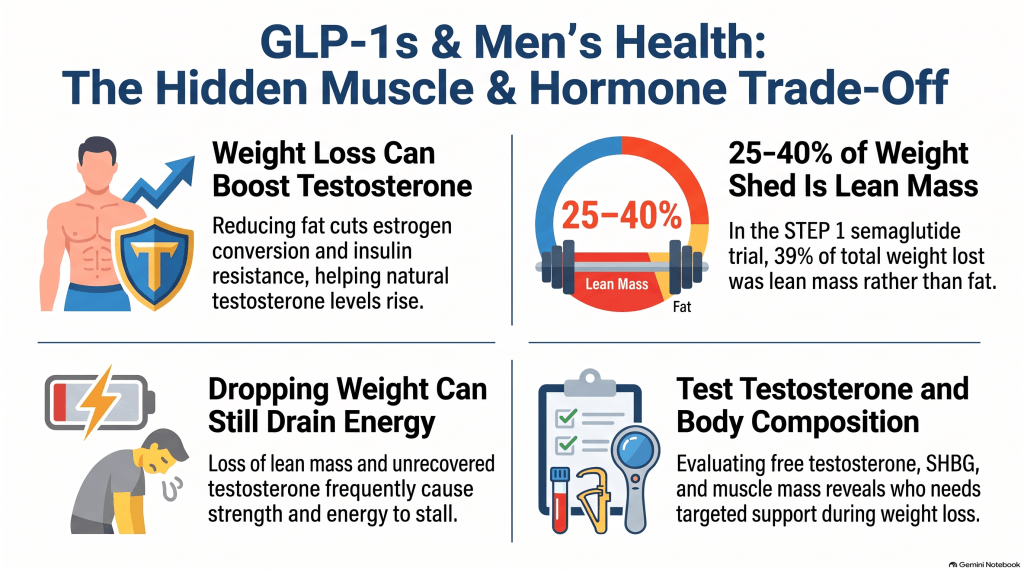
Do GLP-1 medications raise testosterone? Often, yes. In men with obesity, losing weight on semaglutide or tirzepatide reduces fat-driven estrogen conversion and insulin resistance, so testosterone tends to rise. But 25–40% of the weight lost is lean mass, and not every man’s hormones recover. Testing free testosterone, SHBG and body composition shows who needs more support.
In the landmark STEP 1 trial, about 39% of the weight people lost on semaglutide showed up on body-composition scans as lean mass. For a 240-pound man who drops 40 pounds, that can be roughly 15 pounds that was not fat.
Much of that lean loss is water, glycogen and organ tissue rather than pure muscle. Still, men across Port St. Lucie, Stuart, Jupiter and North Palm Beach describe the same pattern: the scale is moving, but energy, drive and strength are not.
The missing piece is often testosterone. Here is what the research shows about GLP-1 medications and low testosterone, and how LifeWell MD manages both at once.
The Metabolic Trap Behind Low Testosterone in Men
Excess body fat and insulin resistance are two of the most common, and most reversible, causes of low testosterone in men over 40. Physicians call this metabolic hypogonadism (also called functional hypogonadism).
How Belly Fat Turns Testosterone Into Estrogen
Visceral fat is rich in aromatase, an enzyme that converts testosterone into estradiol. More abdominal fat means more conversion. Rising estradiol then tells the brain to order less testosterone, and the cycle feeds itself.
How Insulin Resistance Quiets the HPG Axis
Chronically high insulin and low-grade inflammation blunt the signals running along the hypothalamic-pituitary-gonadal (HPG) axis. The pituitary releases less luteinizing hormone (LH), so the testes receive a weaker message to produce testosterone. In many men the testes are healthy; they simply are not being asked to work.
The GLP-1 Promise and Its Blind Spot
GLP-1 receptor agonists such as semaglutide (Ozempic, Wegovy) and tirzepatide (Mounjaro, Zepbound) target both drivers at once. In a study presented at ENDO 2025, men with obesity or type 2 diabetes lost about 10% of their body weight on these drugs. Over 18 months, the share with normal total and free testosterone rose from 53% to 77%.
That is good news, but it leaves nearly one in four men still low. Age-related decline, primary testicular problems, untreated sleep apnea and certain medications do not melt away with the weight. The bathroom scale cannot tell you which group you are in.
Why Rapid GLP-1 Weight Loss Can Undermine Your Androgens
Fast weight loss changes body composition and hormone binding in ways that neither the scale nor a basic lab panel will show you.
Lean Mass Loss: What the Trials Actually Show
- STEP 1 (semaglutide 2.4 mg, 68 weeks): about 15% average weight loss, with roughly 39% of the weight lost measured as lean mass.
- SURMOUNT-1 (tirzepatide, 72 weeks): about 21% weight loss, with roughly 25% measured as lean mass, the same ratio seen with dieting alone.
DEXA “lean mass” includes water, glycogen and organ tissue, so true skeletal muscle loss is smaller than these headlines suggest. But muscle is what drives strength, blood-sugar control and resting metabolism. For a man in his 50s or 60s who is already losing muscle with age, understanding semaglutide muscle loss mechanisms and safety is worth preventing, not shrugging off.
SHBG: Why Total Testosterone Can Mislead You
As insulin falls, the liver makes more sex hormone-binding globulin (SHBG). SHBG binds testosterone and holds it out of reach of your tissues. On a lab report, total testosterone can climb while free testosterone, the fraction your muscles and brain actually use, rises more slowly. In men with an underlying deficiency, it may stay low. A total-testosterone-only test can miss this completely.
Sarcopenic Obesity and the Rebound Risk
Most people regain weight after stopping a GLP-1. In the STEP 1 extension, participants regained about two-thirds of the weight they had lost within a year of stopping semaglutide. Regained weight tends to return as fat faster than muscle is rebuilt. Without a plan to protect lean mass, a man can finish the cycle with less muscle and a similar waistline: a pattern called sarcopenic obesity.
The LifeWell MD Dual-Optimization Protocol
At LifeWell MD, GLP-1 therapy and testosterone are managed as one metabolic plan, by a physician who sees you in person in Port St. Lucie or North Palm Beach, using a functional and integrative medicine approach. It is our Prepare. Protect. Restore. approach applied to your metabolism.
Step 1: Comprehensive Biomarker Mapping
Hormone Panel
Total testosterone (two early-morning draws, as Endocrine Society guidelines recommend), free testosterone, SHBG, estradiol, LH and FSH, plus PSA and hematocrit for safety.
Metabolic Panel
Fasting insulin, HbA1c, lipids, thyroid function and vitamin D.
Body Composition
A baseline DEXA scan, repeated during treatment, so we track lean mass and visceral fat rather than pounds alone.
Step 3: Protein, Resistance Training and Recovery
We set an individualized protein target and a resistance-training plan of two to three sessions a week. For time-pressed members, options include our 21-minute Vasper sessions.
Step 4: Local, Physician-Led Monitoring
As weight drops, SHBG and hormone needs shift. Men already on TRT often need dose changes after starting a GLP-1. We repeat labs and body composition on a set schedule and adjust in person, not through an app.
| What we track | GLP-1 alone, unmonitored | GLP-1 + physician-led hormone optimization |
|---|---|---|
| Fat loss | Substantial | Substantial; testosterone may add visceral fat loss |
| Lean mass | Typically 25–40% of weight lost | Measured by DEXA; protein, training and TRT (when indicated) aim to preserve it |
| SHBG | Rises, usually unmeasured | Measured and read alongside free testosterone |
| Free testosterone | Often never checked | Tested; treated to the normal range when low and symptomatic |
| After stopping | High regain risk | Taper and maintenance plan to protect muscle |
| Safety labs | Varies | Hematocrit, PSA, estradiol and lipids on schedule |
Ready to see what is happening beneath the scale? Book an in-office metabolic and hormone panel at our Port St. Lucie (St. Lucie West) or North Palm Beach office. Serving Palm Beach Gardens, Jupiter, Stuart and the Treasure Coast. Schedule Your Hormone & Metabolic Panel
Frequently Asked Questions About GLP-1s and Testosterone
Can you take testosterone with Ozempic or Mounjaro?
Yes, under physician supervision. Testosterone therapy and GLP-1 medications such as semaglutide (Ozempic, Wegovy) or tirzepatide (Mounjaro, Zepbound) work by different mechanisms and are prescribed together in practice. Testosterone may help preserve lean mass during weight loss. Because no large trial has studied the pair directly, regular labs and dose adjustments are essential.
Why am I still tired on semaglutide even though I’m losing weight?
Common causes include eating too little protein or too few calories, dehydration, lean-mass loss, poor sleep, and gaps in B12, iron or vitamin D. In men, free testosterone that stays low despite weight loss is another frequent cause. Persistent fatigue deserves a full lab workup rather than a lower dose.
Does weight loss alone fix low testosterone?
Sometimes. When low testosterone is driven mainly by obesity and insulin resistance, losing about 10% of body weight can return levels to normal. Men with age-related decline, testicular problems or symptoms that persist after weight loss usually need targeted hormone treatment.
Where can I get GLP-1 and testosterone therapy in Port St. Lucie or Palm Beach County?
LifeWell MD offers physician-led GLP-1 weight management and men’s sexual and hormone health optimization in Florida at two offices: St. Lucie West in Port St. Lucie and North Palm Beach. Both programs begin with an in-person consultation, full hormone and metabolic labs, anFrequently Asked Questions About GLP-1s and Testosterone
Can you take testosterone with Ozempic or Mounjaro?
Yes, under physician supervision. Testosterone therapy and GLP-1 medications such as semaglutide (Ozempic, Wegovy) or tirzepatide (Mounjaro, Zepbound) work by different mechanisms and are prescribed together in practice. Testosterone may help preserve lean mass during weight loss. Because no large trial has studied the pair directly, regular labs and dose adjustments are essential.
Why am I still tired on semaglutide even though I’m losing weight?
Common causes include eating too little protein or too few calories, dehydration, lean-mass loss, poor sleep, and gaps in B12, iron or vitamin D. In men, free testosterone that stays low despite weight loss is another frequent cause. Persistent fatigue deserves a full lab workup rather than a lower dose.
Does weight loss alone fix low testosterone?
Sometimes. When low testosterone is driven mainly by obesity and insulin resistance, losing about 10% of body weight can return levels to normal. Men with age-related decline, testicular problems, or symptoms that persist after weight loss usually need targeted hormone treatment.
Lose the Fat, Keep the Man: Your Next Step
A GLP-1 can be one of the most powerful tools in men’s metabolic health. Used alone and unmonitored, it can also leave you lighter but weaker, with hormones nobody has checked and potential effects on libido and sexual health. The fix is to measure what the scale cannot: free testosterone, SHBG, insulin and lean mass, then treat the cause.
Dr. Ramesh Kumar and the LifeWell Team offer concierge, holistic medical care for men across Palm Beach County and the Treasure Coast. Your first visit includes a full consultation, comprehensive hormone and metabolic labs, and a body-composition baseline, with access to advanced IV therapy options to support energy and recovery.
Book your Metabolic & Hormone Consultation today.
Port St. Lucie: 549 NW Lake Whitney Place, Suite 23B, Port St. Lucie, FL 34986
North Palm Beach: 1201 US Hwy 1, Suite 23B, North Palm Beach, FL 33408
Call: (561) 210-9999
Medical disclaimer: This article is for educational purposes and is not a substitute for individual medical advice. GLP-1 medications and testosterone therapy carry risks, including gastrointestinal effects, elevated red blood cell counts and reduced fertility, and are not right for everyone. Talk with a licensed physician before starting or changing any treatment.
References
- Wilding JPH, et al. Impact of semaglutide on body composition in adults with overweight or obesity: exploratory analysis of the STEP 1 study. J Endocr Soc. 2021. Abstract
- Look M, et al. Body composition changes during weight reduction with tirzepatide in the SURMOUNT-1 study. Diabetes Obes Metab. 2025. PMC11965027
- Portillo Canales S, et al. Anti-obesity medications can normalize testosterone levels in men. ENDO 2025. Endocrine Society
- Ng Tang Fui M, et al. Effects of testosterone treatment on body fat and lean mass in obese men on a hypocaloric diet: a randomised controlled trial. BMC Med. 2016. doi:10.1186/s12916-016-0700-9
- Wilding JPH, et al. Weight regain and cardiometabolic effects after withdrawal of semaglutide: the STEP 1 trial extension. Diabetes Obes Metab. 2022. doi:10.1111/dom.14725
- Bhasin S, et al. Testosterone therapy in men with hypogonadism: an Endocrine Society clinical practice guideline. J Clin Endocrinol Metab. 2018. doi:10.1210/jc.2018-00229
