

Ketamine Therapy in Florida: The Ultimate Guide to Collapsing the Distance to Recovery at LifeWell MD
By Dr. Ramesh Kumar, M.D. — Board-Certified Physician | Harvard-Trained Medical Acupuncturist | LifeWell MD — North Palm Beach & Port St. Lucie
DIRECT ANSWER — What Is Ketamine Therapy and Who Does It Help?
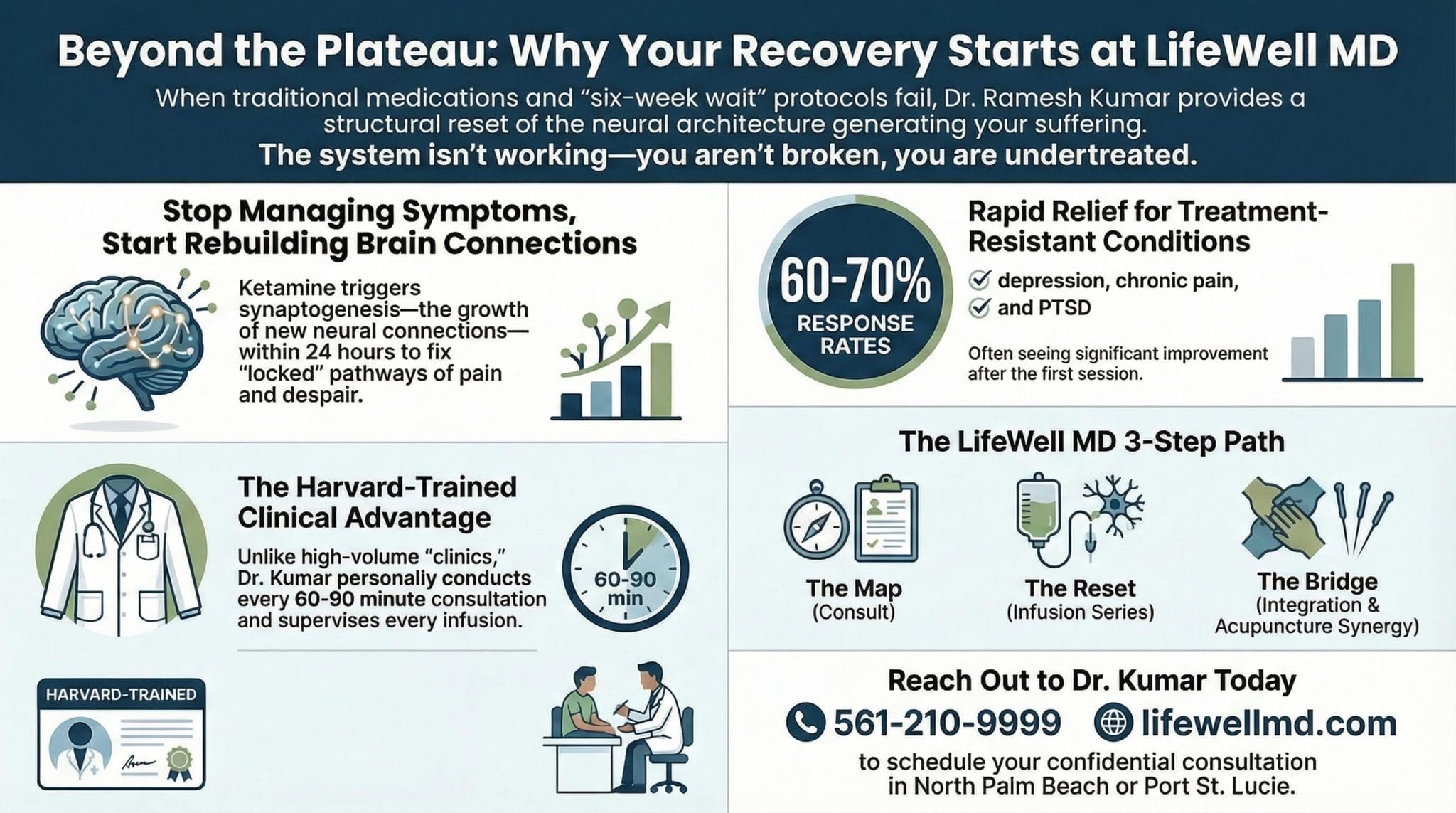
Ketamine therapy is a rapid-acting, physician-administered infusion treatment for treatment-resistant depression (TRD), chronic pain, CRPS, PTSD, and anxiety. Unlike SSRIs that take weeks to produce partial results, ketamine triggers synaptogenesis — the growth of new neural connections — within 24 hours. At LifeWell MD, Harvard-trained Dr. Ramesh Kumar delivers physician-led, precision-calibrated ketamine protocols in North Palm Beach and Port St. Lucie, Florida.
You followed the script.
You waited six weeks for the antidepressant to work and rotated through three pain specialists. Completed the physical therapy, the nerve blocks, and the referrals that led to more referrals. You did everything conventional medicine asked of you.
And you are still suffering.
Here is what that system never told you: if two or more medications have failed you, you do not have a chemical deficiency. You have synaptic degradation — neural pathways locked in a rut of pain, despair, or fear that no SSRI can reach. Every day you wait for a standard prescription to work is another day of life that the illness consumes.
The answer is not another medication. The answer is a structural reset of the neural architecture generating your suffering.
I have spent over 30 years at the intersection of complex disease and human resilience — first as a radiation oncologist who treated patients at their most desperate, now as an integrative physician who rebuilds lives that conventional medicine stopped trying to save. In that time, no clinical tool I have added to LifeWell MD’s integrative medical practice produces this quality of recovery, this quickly, for patients who had stopped believing recovery was possible.
Ketamine therapy is that tool. This is your complete guide. Read every section — then call us.
The Conventional Medical Plateau: Why the System Is Failing You
The Holding Pattern Nobody Admits
Standard psychiatric and pain care follow an identical script. Symptom. Diagnosis. Prescription. Follow-up in six weeks. If the medication fails, a different medication. If that fails, a different dose — a different class — a different combination that produces the same partial result.
Consequently, millions of Americans cycle through this protocol indefinitely. They never fully recover. They never receive a fundamentally different answer. The medical system calls this treatment-resistant depression, treatment-resistant pain, refractory PTSD. The human experience of it carries a different name: the quiet belief that nothing will ever work, that the suffering is permanent, that you are beyond help.
Furthermore, conventional pain management adds its own plateau. Opioids suppress the pain signal temporarily while building tolerance, dependency, and diminishing returns. The dose escalates. The relief contracts. The life narrows around the management of symptoms that never actually resolve.
This plateau is real. It is not a personal failure. And ketamine therapy at LifeWell MD is specifically designed to collapse it.
The Neurobiological Wormhole: How Ketamine Resets What Medication Cannot Reach
To understand why ketamine works when everything else has failed, you need one word: neuroplasticity.
Your brain communicates through synaptic connections — billions of neural pathways built through experience and reinforced by repetition. Depression, chronic pain, and PTSD share one critical neurobiological feature: they all involve progressive synaptic degradation in specific brain regions. The circuits responsible for emotional regulation, rational thought, and pain modulation lose functional connectivity. The brain gets stuck in a loop it cannot exit on its own.
Ketamine directly targets NMDA receptors — glutamate-gated ion channels that govern synaptic plasticity. By blocking these receptors at precise sub-anesthetic doses, ketamine triggers a cascade of neurochemical events that produce something remarkable: synaptogenesis — the rapid growth of brand-new synaptic connections in regions that depression and chronic pain had systematically dismantled.
Additionally, ketamine produces measurable increases in Brain-Derived Neurotrophic Factor (BDNF) — the protein that functions as fertilizer for neural growth. BDNF deficiency is a documented feature of both treatment-resistant depression and chronic pain. Ketamine reverses that deficiency rapidly. The result is not a chemical patch on a broken system. It is a structural reset of the neural architecture that generates your suffering.
This is peer-reviewed, reproducible neuroscience. It is not experimental hope.
Why LifeWell MD: The Harvard-Trained Clinical Advantage
The Florida Wellness Market Has a Problem
The ketamine clinic industry has grown rapidly across South Florida. Walk-in infusions. Package pricing. Group treatment rooms. High volume. Minimal physician oversight.
What most of these centers share is a fundamental misunderstanding: the IV line is not the treatment. The physician calibrating the dose, monitoring the neurological response, and building the protocol around your specific brain chemistry is the treatment. Consequently, the same medication produces profoundly different outcomes depending entirely on who administers it and how.
At LifeWell MD, Dr. Kumar personally conducts every initial consultation — 60 to 90 minutes, no delegated intake, no shortcuts. He reviews your complete psychiatric, medical, and pain history. Assesses your prior treatment responses, cardiovascular profile, and current medications. He builds your clinical map before recommending a single infusion.
The Harvard Acupuncture Synergy — Unavailable Anywhere Else in Palm Beach County
Furthermore, Harvard Medical School training in medical acupuncture gives Dr. Kumar a clinical dimension that no volume ketamine center in Florida offers.
Specific neuro-modulation acupuncture protocols, applied alongside ketamine therapy, actively amplify the neuroplastic window that infusion opens. They extend the duration of synaptic flexibility. They accelerate the consolidation of new, healthy neural patterns before the therapeutic window closes, particularly for older adults benefiting from acupuncture-based care.
Think of ketamine as opening a door. Think of medical acupuncture as holding it open longer. Together, they produce a synergistic depth of recovery that neither treatment generates in isolation.
This combination is the LifeWell MD difference. It does not exist at any high-volume ketamine clinic in Palm Beach County or the Treasure Coast.
Ketamine for Depression: A Revolutionary Treatment for Treatment-Resistant Cases
The “Why” of Treatment-Resistant Depression: The Problem with Traditional SSRIs
Treatment-resistant depression (TRD) occurs when traditional antidepressants, such as selective serotonin reuptake inhibitors (SSRIs), fail to provide relief. SSRIs primarily target serotonin pathways, but in many cases of TRD, the underlying dysfunction involves the brain’s glutamate system. This mismatch means that despite adequate trials of multiple antidepressants, patients continue to experience persistent and severe depressive symptoms. The limitation of SSRIs in addressing glutamatergic dysregulation highlights the urgent need for alternative treatment approaches.
The Mechanism of Action: Ketamine as the Solution
Ketamine offers a novel approach by acting as a noncompetitive antagonist of N-methyl-D-aspartate (NMDA) receptors located on GABAergic interneurons. This blockade reduces excessive inhibitory signaling, leading to a controlled surge of glutamate release. The increased glutamate activates alpha-amino-3-hydroxy-5-methyl-4-isoxazolepropionic acid (AMPA) receptors, which in turn initiate a cascade involving the mammalian target of rapamycin (mTOR) pathway. Activation of mTOR stimulates protein synthesis and synaptogenesis—the formation of new synaptic connections. Additionally, ketamine promotes the release of brain-derived neurotrophic factor (BDNF), supporting neuron survival and growth. This rapid neuroplasticity helps rewire dysfunctional neural circuits, providing fast-acting antidepressant effects distinct from traditional medications.
The 70% Success Rate: Hope for Treatment-Resistant Patients
Clinical trials and real-world studies consistently show that ketamine produces significant symptom improvement in approximately 50 to 70% of patients with treatment-resistant depression. This high success rate marks a breakthrough in psychiatric treatment, especially for individuals who have exhausted conventional options. Ketamine’s rapid onset can provide relief within 40 minutes, offering critical intervention for patients experiencing acute suicidal ideation or severe depressive episodes. This transformative efficacy offers renewed
Ketamine Therapy for Chronic Pain and CRPS: Interrupting the Pain Matrix
Chronic pain is not simply a signal from damaged tissue. In conditions like Complex Regional Pain Syndrome (CRPS), fibromyalgia, and neuropathic pain, the pain persists because the nervous system has learned it. The brain forms durable neural pathways that generate pain independent of any ongoing tissue injury.
This is called central sensitization — and it is precisely why conventional pain management consistently fails these patients. You cannot inject away a learned neural pathway. You cannot prescribe away a pain pattern encoded in synaptic architecture.
Ketamine directly interrupts central sensitization through NMDA receptor blockade. It disrupts the glutamatergic signaling that reinforces chronic pain pathways — creating a neurological window during which the pain matrix can reorganize and new, pain-free patterns can take hold.
Research published in Pain Medicine demonstrates significant reductions in CRPS pain scores following ketamine infusion protocols — with effects persisting months beyond the infusion series.
Additionally, Dr. Kumar’s background in radiation oncology provides unique clinical depth for cancer-related pain, post-surgical neuropathy, and treatment-related nerve damage. These patients deserve more than opioid management, and many with CRPS specifically may benefit from ketamine infusion protocols for CRPS. They deserve a physician who understands their nervous system at a cellular level.
PTSD: The Emotional Wormhole Through Trauma
Trauma rewires the brain structurally. Traumatic experiences produce lasting changes in the amygdala, hippocampus, and prefrontal cortex — creating a nervous system perpetually locked in threat-response mode, replaying traumatic memories with the full physiological intensity of the original event.
Conventional PTSD treatments produce partial response in many patients and complete non-response in a significant subset. The trauma remains encoded in neural architecture that medication and talk therapy alone cannot fully reach.
Ketamine opens the therapeutic wormhole — a neurobiological window of enhanced plasticity during which traumatic memories lose their emotional charge. The nervous system becomes capable of forming new, healthy associations. Research from the Mount Sinai School of Medicine demonstrates that ketamine significantly reduces PTSD symptom scores within 24 hours of infusion — faster than any other available treatment.
Combined with integration support and Dr. Kumar’s acupuncture neuro-modulation protocols, ketamine provides the most rapid and durable PTSD response currently available in clinical practice.
Your 3-Step Path to Recovery at LifeWell MD
| Step | Phase | What Happens |
|---|---|---|
| 01 — The Map | Physician Consultation | 60–90 min with Dr. Kumar personally. Complete clinical audit. Zero delegation. Your protocol is built before a single infusion begins. |
| 02 — The Reset | Ketamine Infusion Series | 6 infusions over 2–3 weeks in a private, medically monitored suite. Dose calibrated to your neurobiology. Continuous vital sign monitoring throughout. |
| 03 — The Bridge | Integration and Consolidation | Structured follow-up, lifestyle optimization, and optional medical acupuncture to lock in and extend the neural gains from infusion. |
The North Palm Beach and Port St. Lucie Experience
Our North Palm Beach office sits minutes from PGA Boulevard — providing the clinical depth and confidentiality that executives in Jupiter, Palm Beach Gardens, and Tequesta expect. No group treatment rooms. No assembly-line intake. A private suite, a physician in the room, and a protocol built around your specific nervous system.
Our Port St. Lucie office serves the Treasure Coast with the identical standard of physician-led care. Folks travel to us from Stuart, Fort Pierce, and Vero Beach specifically because no volume infusion center in the region provides this level of clinical supervision.
Both locations. One standard. Yours.
Serving the South Florida Community That Conventional Medicine Left Behind
At LifeWell MD, we understand the specific pressures of life on Florida’s Gold Coast and Treasure Coast.
Whether you are a high-performing executive in West Palm Beach navigating invisible depression behind a successful exterior, a chronic pain patient in Stuart who has stopped believing relief is possible, a veteran in Port St. Lucie carrying PTSD that therapy alone has not resolved, or a cancer survivor in Vero Beach managing treatment-related neuropathy that no one has adequately addressed — Dr. Kumar is ready to build your protocol.
You are not broken. You are undertreated. There is a profound difference between those two realities. Ketamine therapy at LifeWell MD is where that difference becomes clinically actionable, alongside other advanced IV therapies such as NAD, CBD, ozone, and high-dose vitamin C.
Frequently Asked Questions About Ketamine Therapy in Florida
Q1. Is ketamine therapy safe for long-term use?
Yes — when administered by a qualified physician in a controlled clinical setting. Ketamine is a dissociative anesthetic, not an opioid; it has carried FDA approval as an anesthetic since 1970 and holds one of the most extensively documented safety records in clinical medicine. At LifeWell MD, Dr. Kumar screens every patient thoroughly for contraindications — including uncontrolled hypertension, active psychosis, and specific cardiac conditions — before any infusion begins. Vitals are monitored continuously throughout every session. Long-term maintenance protocols follow objective response assessment, not arbitrary timelines.
Q2. How is ketamine therapy different from taking antidepressants?
Antidepressants modulate the monoamine system — serotonin, dopamine, norepinephrine — and require four to eight weeks to produce effects, often partial. Ketamine targets the glutamate system and triggers synaptogenesis — the physical growth of new neural connections — within hours of the first infusion. Additionally, ketamine addresses the synaptic degradation underlying depression structurally, rather than chemically supplementing a depleted neurotransmitter system, and physician-calibrated protocols are designed to minimize issues like ketamine tolerance and diminished response over time. For patients who have failed antidepressants, this mechanistic difference is clinically decisive.
Q3. What does a ketamine infusion actually feel like?
Most patients enter a deeply relaxed, mildly dissociative state during infusion. Colors may intensify. Perceptions of time and space shift temporarily. Many patients describe the experience as profoundly peaceful — a disconnection from the mental noise that has defined their daily existence. Some access emotional insights during infusion that weeks of conventional therapy had not produced. The experience is private, physician-monitored, and takes place in a controlled clinical environment — not a group room, not a spa setting.
Q4. How soon will I feel results after my first ketamine infusion?
Most patients with treatment-resistant depression notice meaningful improvement within 24 hours of their first infusion. Chronic pain and PTSD responses typically emerge within the first two to three sessions. The most durable and comprehensive results develop over the complete six-infusion initial series — as synaptogenesis matures and new neural patterns consolidate. Dr. Kumar formally reassesses your response at defined intervals and adjusts the protocol based on objective clinical findings.
Q5. Does insurance cover ketamine infusion therapy in Florida?
Most insurance plans currently classify ketamine infusion therapy for psychiatric and pain indications as investigational. LifeWell MD operates as a concierge, cash-based practice — which means your treatment protocol is dictated entirely by your clinical needs and Dr. Kumar’s medical judgment, not an insurance adjuster’s coverage criteria. We provide complete, transparent pricing during your consultation and discuss flexible payment arrangements where appropriate.
Q6. Can ketamine therapy help if I also have chronic spine pain or nerve damage?
Yes — and this is one of ketamine’s most underappreciated applications. Spine-related chronic pain, post-surgical nerve damage, and neuropathic pain syndromes all involve central sensitization mechanisms that ketamine directly interrupts through NMDA receptor blockade. Furthermore, Dr. Kumar’s background in radiation oncology and integrative medicine provides unique clinical depth for complex pain presentations involving nerve injury, treatment-related neuropathy, and musculoskeletal pain that has centralized into a self-sustaining neural loop. If conventional pain management has reached its ceiling for you, ketamine therapy frequently creates a clinical opening that nothing else has.
Q7. Is physician-supervised ketamine therapy available in both North Palm Beach and Port St. Lucie?
Yes. LifeWell MD provides physician-led ketamine infusion therapy at both our North Palm Beach and Port St. Lucie locations — serving the full Palm Beach County and Treasure Coast region. Dr. Kumar personally evaluates every patient, designs every infusion protocol, and supervises every session at both offices. Patients travel to us from Jupiter, Palm Beach Gardens, Tequesta, West Palm Beach, Stuart, Fort Pierce, and Vero Beach for physician-calibrated care that no volume infusion center in Florida replicates. Call 561-210-9999 or visit LifeWellMD.com to schedule your confidential consultation today.
Q8: Does Ketamine Therapy get you high?
Ketamine therapy, when administered in controlled medical settings, is designed to provide therapeutic benefits without the recreational “high” associated with misuse. The doses used in treatment are carefully calibrated by healthcare professionals to avoid intense dissociative effects while promoting healing and symptom relief. Patients are closely monitored throughout the infusion to ensure safety and comfort, minimizing any unwanted psychoactive experiences.
Q9. Does Ketamine Therapy help weight loss?
Weight gain is a common challenge associated with mental health issues such as depression and anxiety. Ketamine therapy helps by rapidly relieving these symptoms, promoting neuroplasticity and resetting neural pathways that improve mood and motivation. As mental health improves, patients often experience enhanced emotional regulation and increased energy, which can support healthier lifestyle choices and aid in weight management.
Ready to Collapse the Distance to Your Recovery?
You have spent enough time in the holding pattern.
Ketamine therapy at LifeWell MD does not offer you another medication to try, another specialist to see, or another six weeks of waiting. It offers you a neurobiological reset — physician-supervised, precision-calibrated, and built around the specific architecture of your nervous system.
The only appointment you will regret is the one you never made.
Stop managing your suffering. Start resolving it.
Schedule Your Confidential Ketamine Consultation at LifeWell MD
North Palm Beach — minutes from PGA Boulevard Port St. Lucie — serving the full Treasure Coast
Serving Jupiter | Palm Beach Gardens | Tequesta | West Palm Beach | Stuart | Fort Pierce | Vero Beach
Call 561-210-9999 or visit LifeWellMD.com
Physician-led. Harvard-trained. Built around you.
About the Author
Dr. Ramesh Kumar, M.D. is a board-certified physician with over 30 years of clinical experience, including Harvard Medical School training in medical acupuncture and the founding of four cancer centers during his oncology career. His work at LifeWell MD integrates ketamine infusion therapy, advanced diagnostics, hormonal optimization, acoustic wave therapy, ozone therapy, and medical acupuncture within a concierge, physician-led model — serving complex patients and accomplished professionals across North Palm Beach and Port St. Lucie, Florida.
His approach to medicine is shaped by three decades of treating human suffering at its most profound — and the conviction that every patient who has run out of conventional options deserves a physician willing to go further.

Clinical References & Authority Sources
- Murrough JW, et al. Antidepressant efficacy of ketamine in treatment-resistant major depression. American Journal of Psychiatry, 2013.
- Feder A, et al. Efficacy of intravenous ketamine for treatment of chronic PTSD. JAMA Psychiatry, 2014.
- Sigtermans MJ, et al. Ketamine produces effective and long-term pain relief in CRPS patients. Pain Medicine, 2009.
- Duman RS & Aghajanian GK. Synaptic dysfunction in depression: potential therapeutic targets. Science, 2012.
- Harvard Health Publishing. Ketamine for treatment-resistant depression. Harvard Medical School. https://www.health.harvard.edu
- National Institute of Mental Health. Treatment-Resistant Depression. https://www.nimh.nih.gov
© LifeWell MD. Content reviewed by Dr. Ramesh Kumar, M.D. This article is for informational purposes only and does not constitute medical advice. Consult a qualified physician for personal diagnosis and treatment. For more information on our commitment to inclusive access, please review our website accessibility statement, and for complementary modalities that support healing and recovery, explore our whole-body red light therapy offerings.
Please check out his 120 five star reviews on Healthgrades and his 136 five star reviews at WebMD.
