
Nov 17, 2026 · @kumar
Medically reviewed by Ramesh Kumar, MD | Board-Certified Radiation Oncologist | Harvard-Trained Medical Acupuncture Physician
In 1996, cancer researchers in Hershey, Pennsylvania, found a gene that slowed the spread of melanoma. They named it KiSS-1, after the town’s famous chocolate. Seven years later, scientists realized its protein does something far more surprising: it acts as the master switch for human puberty and fertility. Today, kisspeptin peptides are among the most searched in men’s health, and kisspeptin 10 is the version you’ll see most often online.
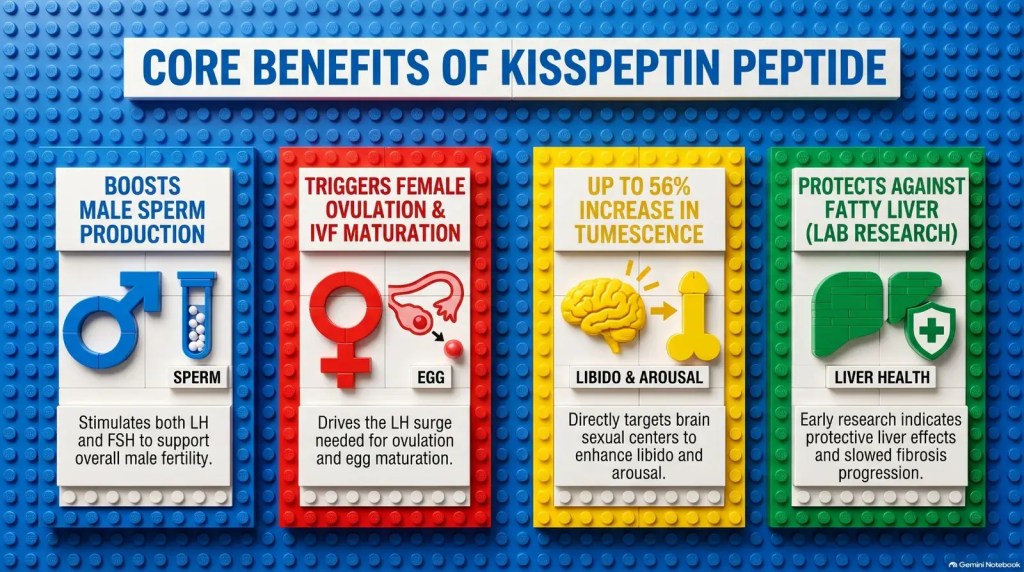
The appeal is simple. Testosterone replacement therapy (TRT) supplies the hormone from outside, and the body responds by shutting down its own production. Kisspeptin works at the top of the chain, asking your brain to restart the signal your testes already know how to answer. That is the difference between exogenous replacement and endogenous neuroendocrine optimization.
The best candidates are men whose testes still work but whose brain signal is weak: low or “normal-low” LH alongside low testosterone, often with obesity, type 2 diabetes, or a wish to preserve fertility. This guide covers what the research shows, what the kisspeptin dosage studies used, and where kisspeptin 10 stands with the FDA in 2026.
Kisspeptin 10 at a glance
- What it does: Activates the KISS1R receptor, triggering GnRH and then natural LH and FSH pulses.
- Best fit: Secondary (brain-driven) hypogonadism with healthy testes.
- Half-life: About 4 minutes, so timing and rhythm matter more than size of dose.
- Status: Investigational, not FDA-approved, and still on FDA’s Category 2 compounding list.
What Is Kisspeptin? Mechanism of Action and Isoforms
So, what is kisspeptin? Kisspeptin peptides are a family of signaling molecules made from the KISS1 gene. They bind a receptor called KISS1R (originally named GPR54) on the GnRH neurons of the hypothalamus. People born without working KISS1R never go through puberty, which shows how central this signal is.
The body makes one long precursor and cuts it into several active pieces. Kisspeptin-54 is the full-length form; kisspeptin-14, -13 and -10 are shorter fragments. All of them share the same 10-amino-acid tail that binds the receptor. Kisspeptin 10 is that tail alone: the smallest piece with full activity, and the simplest and cheapest to make.
Shorter does not mean equivalent. Kisspeptin 10 clears from the blood in about 4 minutes, while kisspeptin-54 lasts closer to half an hour. In animal work, kisspeptin-54 also seems to reach the brain more easily, which helps explain why most human trials have used the longer form.
Once kisspeptin binds KISS1R, the hypothalamus releases a pulse of GnRH. The pituitary answers with LH and FSH. In men, LH tells the Leydig cells to make testosterone, and FSH supports sperm production. The rhythm matters: the system is built to respond to pulses, not to a constant signal.
Kisspeptin 10 for Testosterone and Male Fertility
The case for kisspeptin 10 for testosterone rests on a small set of careful human studies. In the first-in-human trial at the University of Edinburgh, IV kisspeptin-10 raised LH within minutes in healthy men. A 22.5-hour infusion lifted testosterone from 16.6 to 24.0 nmol/L and increased the number of LH pulses. In men with type 2 diabetes and low testosterone, a 12-hour infusion raised testosterone from 8.5 to 11.4 nmol/L.
Because the signal starts in the hypothalamus, the testes do the work themselves. That is why kisspeptin interests men who want to protect intratesticular testosterone, testicular volume and sperm production, and why getting kisspeptin 10 dosage and titration right matters more than simply chasing higher numbers. Here is how it compares with the tools men usually hear about:
| Option | Where it acts | Natural LH and FSH | Sperm production |
|---|---|---|---|
| TRT | Replaces testosterone directly | Suppressed | Often falls |
| hCG | Mimics LH at the testes | Bypassed; FSH not driven | Partly preserved |
| Enclomiphene | Blocks estrogen feedback at the brain and pituitary | Raised | Generally preserved |
| Gonadorelin | Synthetic GnRH at the pituitary | Raised if given in pulses | Generally preserved |
| Kisspeptin 10 | Above GnRH, at the hypothalamus | Raised through the body’s own pulses | Expected to be preserved; long-term data lacking |
| In principle, kisspeptin could serve as a standalone option for secondary hypogonadism or as support alongside TRT. It cannot help primary hypogonadism, where the testes themselves have failed. Neither use has been tested in long-term trials, and no one has published outcome data on men taking it for months. |
Core Kisspeptin Peptide Benefits
The kisspeptin peptide benefits supported by human data fall into three areas, with a fourth still in the lab.
Male fertility. By driving both LH and FSH, kisspeptin supports the two hormones sperm production depends on, rather than testosterone alone.
Female fertility. Kisspeptin helps trigger the LH surge behind ovulation. Imperial College London has used kisspeptin-54 to trigger egg maturation in IVF for women at high risk of ovarian hyperstimulation. Women respond differently by cycle phase: kisspeptin-10 raised LH around ovulation but not in the early follicular phase. For some women, especially those with low libido or mood changes, carefully monitored testosterone cream for women may be another hormone tool in the broader fertility and sexual-health conversation.
Libido and arousal. Kisspeptin receptors sit throughout the brain’s emotional and sexual centers, not just the hypothalamus. In a 2023 JAMA Network Open trial of 32 men with low sexual desire, a kisspeptin infusion changed activity in sexual-processing brain regions and increased penile tumescence by up to 56% versus placebo. A similar study in women reported comparable brain effects, supporting kisspeptin as a natural libido and sexual function booster.
Because these receptors live in the brain’s limbic system, researchers think kisspeptin acts on desire directly, apart from its effect on testosterone. Note that these trials used IV kisspeptin-54, not kisspeptin 10 injections.
Metabolic health (early research). In mice on a high-fat diet, activating the liver’s kisspeptin receptor protected against fatty liver and slowed progression to fibrosis. Patients with fatty liver also had higher kisspeptin levels, which may be a protective response. The human testosterone data in type 2 diabetes add to the metabolic interest, and they parallel some of the whole-body benefits seen in peptide therapy success stories, but no trial has tested kisspeptin as a metabolic treatment.
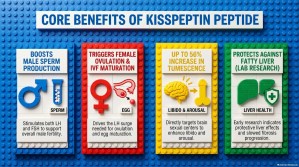
Kisspeptin research spans fertility, sexual arousal, and liver health. The findings shown should not be read as established treatment benefits.
Clinical Kisspeptin Dosage and Administration Protocols
There is no FDA-approved kisspeptin dose. Everything below comes from published research, so treat it as context, not a home protocol.
Why rhythm beats size. With a 4-minute half-life, kisspeptin 10 rises and disappears quickly, much like the natural pulses it mimics. More is not better: in the Edinburgh trial, an IV dose of 3 µg/kg produced a smaller LH response than 1 µg/kg.
Tachyphylaxis. Constant stimulation can make the receptor stop responding. In women with hypothalamic amenorrhea, twice-daily kisspeptin-54 injections lost most of their LH effect by day 14, while twice-weekly dosing kept working for 8 weeks. Over-stimulation can paradoxically suppress the axis it is meant to support.
What the studies actually used. Each kisspeptin 10 dose in human research was weight-based and mostly given by vein:
- IV bolus: 0.3 to 1 µg/kg raised LH in healthy men and in men with type 2 diabetes.
- IV infusion: 1.5 to 4 µg/kg per hour, for 9 to 22.5 hours, under supervision.
- Subcutaneous pump (2026): A placebo-controlled study ran kisspeptin-10 for 8 hours a day, then 16 hours off, for 12 days. LH stayed raised on day 12. A continuous 5-day infusion kept testosterone up but did not keep LH up.
No trial has tested the fixed daily or weekly subcutaneous injections promoted by research-peptide sellers. Any reputable protocol would need pharmaceutical-grade product, refrigerated handling after reconstitution, and timing that respects the morning testosterone peak, and should be framed within a broader, physician-guided peptide therapy approach.
Labs that guide an individualized kisspeptin dosage. Baseline and follow-up panels should include total and free testosterone, LH, FSH, estradiol, SHBG and prolactin, drawn in the morning. Add hematocrit, PSA and a semen analysis when fertility is the goal.
Safety Profile, Contraindications, and Compounding Quality
In the short, supervised human studies, kisspeptin was generally well tolerated. The effects people most often mention are transient flushing, mild injection-site irritation and headache, similar to the local reactions seen with other peptide therapy side effects. Long-term safety has not been studied.
Who should not use kisspeptin:
- Hormone-sensitive cancers, such as prostate or breast cancer, now or in the past
- Known pituitary tumors
- Pregnancy or breastfeeding
- Men with primary testicular failure, who will not respond
Where kisspeptin 10 stands with the FDA. Kisspeptin-10 is not FDA-approved. Since September 2023 it has been on FDA’s Category 2 list of substances that raise significant safety risks in compounding. FDA cited possible immune reactions, peptide impurities and limited safety data. FDA’s advisory committee voted against adding it to the compounding list in October 2024.
It was not among the 12 peptides FDA removed from Category 2 in April 2026, or the six covered by HHS’s October 2026 enforcement policy.
In practice, that means a licensed US compounding pharmacy should not be making kisspeptin-10 right now. Vials sold online as “research use only” are not tested or labeled for people, and purity, dose and sterility are unknown. At LifeWell MD, we follow these rules and track the regulatory process closely.
Frequently Asked Questions
What is kisspeptin and how does it differ from hCG?
Kisspeptin is a natural brain peptide that triggers GnRH, which then drives your own LH and FSH. hCG skips the brain and pituitary entirely: it imitates LH at the testes. That makes hCG stronger and more predictable, but it does not drive FSH, while kisspeptin works through the body’s full chain of command.
How long does kisspeptin 10 for testosterone take to improve lab markers?
In research settings, LH rises within minutes of an IV dose and testosterone rises over hours of infusion. No published trial has followed men on kisspeptin injections for months, so there is no validated timeline for lasting lab changes.
What is a standard starting kisspeptin 10 dose for men?
There isn’t one. Published studies used weight-based IV doses of roughly 0.3 to 1 µg/kg, or supervised infusions. Fixed online doses come from research-peptide communities, not clinical trials.
Can kisspeptin peptides be stacked with testosterone replacement therapy?
In theory, kisspeptin could keep the testes’ own signal active during TRT, much as hCG is used today. No study has tested this combination, and kisspeptin-10 cannot currently be compounded legally in the US. A physician can discuss proven ways to protect fertility on TRT.
Physician-Guided Peptide Therapy in North Palm Beach & Port St. Lucie
Kisspeptin 10 is one of the most elegant ideas in men’s health: restore the body’s own signal instead of overriding it. The science is real, but it is early, short-term and mostly intravenous, and the peptide is not legally compounded in the US today. That is exactly why the first step is not a vial. It is a precise map of your hypothalamic-pituitary-gonadal axis.
At LifeWell MD, every LifeWell Member works directly with Dr. Kumar, a board-certified, Harvard-trained physician at our personalized, holistic healthcare practice. We start with diagnostic hormone mapping: morning testosterone, LH, FSH, estradiol, SHBG and prolactin, plus a semen analysis when fertility matters. Then we build a personalized plan from the options that are safe, legal and proven for your pattern, drawing on our broader health and wellness services when appropriate. We also follow kisspeptin’s regulatory status, so you hear from us first if that changes, and we integrate updates into our telehealth and in-person care model.
Ready to find out where your signal is breaking down? Schedule a clinical consultation at our North Palm Beach office or our Port St. Lucie office at 549 NW Lake Whitney Place, Suite 23B. Phone number (561) 210-9999
This article is for education only and is not medical advice. Kisspeptin-10 is not FDA-approved. Regulatory details reflect information available as of November 17, 2026, and may change.
A video summarizing the content of this blog post:
