
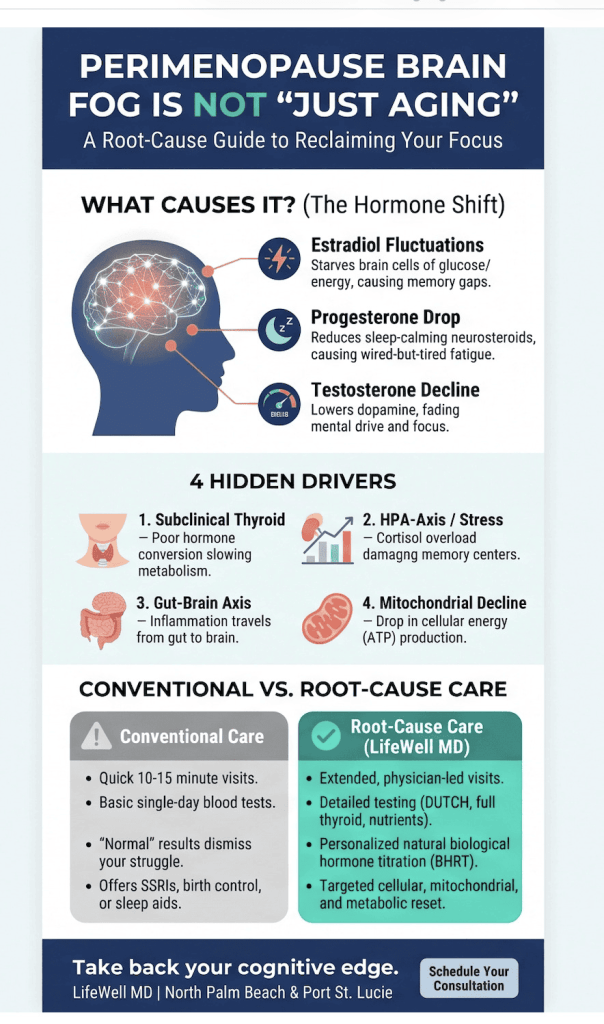
Perimenopause Brain Fog Is Not “Just Aging”: Root-Cause Care in Palm Beach & the Treasure Coast
You walk into a high-stakes meeting and the exact word you need vanishes. You reread the same email three times. By 2:00 p.m., your mental stamina has quit for the day. If you are in your 40s or early 50s and this cognitive decline is new, you are not imagining it—and it is not simply aging.
Perimenopause brain fog is one of the most disruptive neurological shifts of the midlife transition. Yet thousands of high-performing women hear the exact same verdict after a rushed medical visit: “Your labs are normal.” You walk out with a prescription for an antidepressant, a synthetic birth control pill, or a sleep aid. These medications blunt symptoms while completely ignoring why your brain is starving for energy.
At LifeWell MD, we reject symptom suppression. Our physician-led neuro-endocrine evaluation analyzes your hormones, thyroid conversion, stress physiology, gut microbiome, and cellular metabolism together. We map the exact biological bottlenecks draining your focus—and build a precision protocol to restore your cognitive edge.
What Causes Brain Fog During Perimenopause?
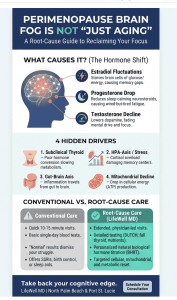
Perimenopause brain fog is caused primarily by erratic 17β-estradiol fluctuations, declining progesterone, and depleted free testosterone. These neuro-active hormones regulate cerebral glucose metabolism, GABA-mediated neural calm, and dopamine signaling. When hormone levels destabilize, working memory, word retrieval, executive focus, and sleep architecture deteriorate.
Estradiol Swings and Cerebral Glucose Starvation
17β-estradiol acts as the master regulator of brain bioenergetics, instructing neurons to uptake and burn glucose for fuel. During perimenopause, estradiol does not decline in a straight line; it spikes erratically before plummeting. Quantitative brain imaging demonstrates that cerebral glucose metabolism drops by up to 25% across the menopausal transition. Your neurons are literally under-fueled during high-demand cognitive tasks like multitasking, rapid word recall, and sustained executive focus.
Progesterone Drop, Allopregnanolone, and Neural Static
Progesterone metabolizes in the brain into allopregnanolone, a potent neurosteroid that binds to GABA receptors to calm neural circuitry. Because anovulatory cycles increase during early perimenopause, progesterone is always the first hormone to drop. Without adequate allopregnanolone, you lose deep delta-wave sleep, wake up at 3:00 a.m. with a racing mind, and spend your workday fighting cognitive static and low-grade anxiety.
Testosterone Depletion and Executive Drive
Testosterone is a critical female neuro-hormone that declines steadily starting in your 30s, and in men this same hormone is central to the integrative sexual health care we provide. Optimal free testosterone directly supports dopamine signaling, spatial cognition, working memory, and mental stamina. Unaddressed testosterone depletion leaves you with flat motivation and an inability to push through complex intellectual work.
Why Conventional Medicine Misses the Diagnosis
Standard medical care is engineered for acute disease, not cognitive optimization. A 12-minute conventional appointment relies on a basic TSH and a single-day estradiol draw compared against broad population reference ranges. Those bell curves reflect an increasingly sick, symptomatic population—not the physiological zones required to keep your brain firing at peak capacity.
Timing is the second clinical blind spot. Because perimenopausal hormones swing wildly from day to day, a random blood draw frequently looks “normal” on paper while your cellular receptors are starving. Worse, prescribing oral contraceptives or SSRIs actively compounds the problem. Synthetic birth control elevates Sex Hormone-Binding Globulin (SHBG)—trapping your remaining free testosterone—while depleting intracellular B vitamins, magnesium, and zinc required for neurotransmitter synthesis.
| Clinical Metric | Standard Conventional Care | LifeWell MD Functional Approach |
|---|---|---|
| Diagnostic Testing | Basic TSH; occasional single-day serum Estradiol. | Full Thyroid Panel (Free T3, Free T4, Reverse T3, TPO/TgAb antibodies), DUTCH Complete, Metabolomics, hs-CRP, and Homocysteine. |
| Lab Interpretation | Broad population bell-curve averages. | Optimal physiological ranges calibrated to your clinical symptoms and cognitive performance. |
| Test Timing | Single random blood draw regardless of cycle day. | Precision luteal-phase timing and serial tracking to map hormonal trends. |
| Primary Treatment | SSRIs, synthetic oral contraceptives, and sedative sleep aids. | Physiologic Bioidentical Hormone Replacement Therapy (BHRT), peptides, and targeted mitochondrial regeneration. |
| Physician Access | 10-to-15-minute rushed encounter with mid-level handoffs. | Extended, unhurried root-cause consultations with direct MD follow-up. |
4 Hidden Drivers That Amplify Perimenopausal Brain Fog
Sex hormones never operate in a vacuum. In clinical practice, we routinely uncover four secondary physiological drivers accelerating midlife cognitive decline, a pattern we also see across our broader integrative concierge medical services.
1. Subclinical Hypothyroidism and Cellular Thyroid Resistance
A “normal” TSH frequently hides severe thyroid underperformance at the cellular level. Chronic stress, inflammation, and nutrient deficiencies block the conversion of inactive T4 into active Free T3, shunting hormone into Reverse T3—which acts as a metabolic brake on brain cells. Furthermore, autoimmune Hashimoto’s antibodies often attack thyroid tissue for up to a decade before TSH ever flags abnormal on a standard lab slip.
2. HPA-Axis Dysfunction and Cortisol Neurotoxicity
High-performing women often run on adrenaline and cortisol for decades. Chronically elevated cortisol impairs synaptic plasticity and is clinically linked to measurable atrophy in the hippocampus—the brain’s primary memory-processing center. Over time, your diurnal Hypothalamic-Pituitary-Adrenal (HPA) axis flattens, leaving you mentally exhausted at 8:00 a.m. and wired at midnight.
3. Gut-Brain Axis Disruption and Microglial Inflammation
The estrobolome—the specific colony of gut bacteria responsible for metabolizing and recycling estrogen—destabilizes during perimenopause. When intestinal permeability increases, bacterial lipopolysaccharides (endotoxins) leak into systemic circulation, cross the blood-brain barrier, and activate microglia (the brain’s resident immune cells). You do not feel brain inflammation as pain; you experience it as slow processing speed and mental fog.
4. Mitochondrial Burnout and ATP Depletion
Neurons demand massive, uninterrupted amounts of ATP (cellular energy). Because estradiol directly protects mitochondrial membranes, falling hormone levels trigger mitochondrial slowdown and oxidative stress. When combined with sub-optimal ferritin (iron storage), Vitamin B12, or CoQ10, your brain simply cannot generate the voltage required for sharp focus.
Our 4-Pillar Protocol for Clearing Perimenopause Brain Fog
At LifeWell MD, every treatment architecture is built from your quantitative biomarker data—never a one-size-fits-all template, reflecting our functional medicine approach in North Palm Beach and our broader personalized, holistic healthcare solutions.
1. Advanced Functional Diagnostics
- Diurnal Cortisol & Hormone Metabolite Mapping: Utilizing the DUTCH Complete panel to evaluate estrogen methylation pathways, progesterone metabolites, and adrenal rhythm.
- Complete Thyroid Execution Panel: Measuring TSH, Free T3, Free T4, Reverse T3, and thyroid antibodies.
- Intracellular Micronutrient & Anemia Profiling: Optimizing Ferritin, active Vitamin B12, RBC Folate, Omega-3 Index, and Vitamin D3, often coordinating with evidence-based brain-boosting nutritional supplements when appropriate.
- Cardiometabolic & Neuro-Inflammatory Markers: Assessing fasting insulin, HbA1c, hs-CRP, and Homocysteine.
2. Physiologic Bioidentical Hormone Optimization (BHRT)
When neuro-endocrine deficiency is confirmed, we restore balance using FDA-approved and custom-compounded bioidentical hormones at precise physiologic doses: transdermal estradiol, oral micronized progesterone at bedtime to restore deep sleep architecture, and titrated transdermal testosterone.
We strictly favor adjustable transdermal and oral delivery systems paired with rigorous lab monitoring over high-dose surgical hormone pellets, consistent with our broader holistic medical services in Palm Beach and our dedicated acupuncture clinic for health and wellness, all grounded in LifeWell MD’s personalized, holistic care model. Franchise med-spa pellets frequently lock women into supraphysiologic hormone spikes that cannot be removed once inserted, triggering weight gain, irritability, and receptor downregulation. While BHRT rapidly resolves vasomotor symptoms and sleep fragmentation, we treat the entire metabolic ecosystem to ensure complete cognitive recovery.
3. Mitochondrial and Neuro-Regenerative Therapies
Our mitochondrial and neuro-regenerative therapies include advanced IV options such as NAD and high-dose Vitamin C, similar to the IV therapy offerings at our Port St. Lucie clinic; these protocols can also intersect with NAD+ IV therapy for autoimmune diseases and NAD treatment approaches for Parkinson’s disease in appropriate clinical contexts.
- Harvard-Trained Medical Acupuncture: Modulating autonomic nervous system tone, increasing cerebral blood flow, and downregulating neuroinflammation, with our broader overview of acupuncture benefits, techniques, and effectiveness providing additional context on how these mechanisms support whole-body healing.
- Stress Management and Resiliency Training (SMART): Evidence-based mind-body neuro-regulation developed at Harvard Medical School’s Benson-Henry Institute, often integrated with advanced medical acupuncture and acupuncture for allergy-related immune dysregulation for comprehensive nervous system regulation.
- NAD+ Cellular Therapy: Replenishing Nicotinamide Adenine Dinucleotide to directly fuel neuronal mitochondria and DNA repair.
- Transcranial Photobiomodulation: Applying targeted near-infrared light therapy to stimulate cytochrome c oxidase in brain mitochondria and accelerate cognitive recovery, complementing other therapies like acupuncture for chronic pain relief whose cost and value considerations many patients also evaluate.
4. Metabolic and Circadian Reset
Glycemic volatility is the primary driver of the 2:00 p.m. mental crash, and complementary photobiomodulation options such as advanced red light therapy for cellular repair and cognitive support can further enhance metabolic and neurological resilience. We flatten blood-sugar spikes using protein-centric nutritional timing and Continuous Glucose Monitoring (CGM) data, strategies we also highlight in our holistic health and wellness insights blog. Simultaneously, we re-anchor your suprachiasmatic nucleus (master circadian clock) using morning phototherapy and vagus nerve HRV biofeedback to lock in restorative sleep.
Physician-Led Perimenopause Care in Palm Beach County & the Treasure Coast
LifeWell MD provides concierge functional and integrative medicine for women across North Palm Beach, Palm Beach Gardens, Jupiter, West Palm Beach, Boca Raton, Stuart, Port St. Lucie, and Vero Beach.
Your diagnostic evaluation and longitudinal care are directed personally by Dr. Ramesh Kumar, MD—a board-certified physician with over three decades of clinical experience and specialized postgraduate training from Harvard Medical School in Medical Acupuncture and Stress Management & Resiliency Training. You will never be handed off to an algorithm-driven med-spa or a rotating cast of mid-level providers. As a dedicated private practice, we invest the clinical time required to solve complex neuro-hormonal cases.
Comprehensive, in-person root-cause evaluations are available at both our North Palm Beach and Port St. Lucie clinics.
Frequently Asked Questions About Perimenopause Brain Fog
How do I know if my brain fog is perimenopause or early dementia?
Perimenopausal brain fog fluctuates alongside cycle shifts, night sweats, and sleep disruption, primarily impacting verbal word retrieval, working memory, and multitasking. Landmark longitudinal research (including the SWAN Study) confirms this transition is driven by neuro-energetic hormone shifts rather than structural neurodegeneration. In contrast, getting lost in familiar environments, inability to execute routine daily tasks, or progressive decline noticed by family members requires immediate neurological workup. At LifeWell MD, we screen for and address both metabolic and neurodegenerative risk factors.
Can you have perimenopausal brain fog if your periods are still regular?
Yes. Perimenopause begins inside the brain years before your menstrual calendar changes. Luteal-phase progesterone decline and erratic estradiol signaling frequently start in a woman’s late 30s or early 40s while cycles still arrive every 28 days. Waiting until your periods stop to evaluate your hormones means enduring years of preventable cognitive and sleep disruption.
How fast does bioidentical hormone therapy clear brain fog?
Clinical timeline depends on your baseline metabolic and adrenal health. Most women experience deeper, uninterrupted sleep and reduced nighttime anxiety within 2 to 4 weeks of restoring physiologic progesterone. Sharper word recall, sustained afternoon focus, and executive stamina typically rebuild over 8 to 12 weeks as estradiol, thyroid conversion, and mitochondrial ATP production stabilize. We re-test biomarkers to fine-tune your dosing with precision.
Where can I get comprehensive functional hormone testing in Palm Beach County or the Treasure Coast?
LifeWell MD provides comprehensive functional neuro-endocrine testing—including DUTCH Complete hormone mapping, full thyroid conversion panels, cardiometabolic profiling, and intracellular nutrient diagnostics—at our clinics in North Palm Beach and Port St. Lucie, Florida. Every diagnostic panel is interpreted directly with you by Dr. Kumar.
Schedule Your Root-Cause Consultation
Cognitive decline does not have to be the price of entering your prime leadership years. Stop settling for rushed visits and “normal” lab slips. Schedule your comprehensive root-cause evaluation at our North Palm Beach or Port St. Lucie clinic today, and let us test, map, and restore your mental edge.
Disclaimer: This article is for educational purposes only and does not constitute individualized medical advice or establish a physician-patient relationship.
Check This Video That Summarizes This Content:
