
After Prostate Cancer: You Can Be Grateful—and Still Want Your Sex Life Back
By Dr. Ramesh Kumar
The following is an illustrative composite based on concerns commonly encountered in survivorship—not a specific patient’s story.
The follow-up went well. His doctor is pleased. Consequently, the next PSA test is scheduled.
At home, everyone is relieved. He is relieved, too.
However, when the house grows quiet, another conversation remains unspoken.
His erections have changed. He hesitates before reaching for his partner, wondering whether a moment of affection will become another moment of disappointment. He remembers the discussion before treatment. He knew his sex life might change.
What he does not know is who will help him now.
“They warned me my sex life might change. Nobody told me who would help me afterward.”
You can be grateful that treatment controlled your cancer and still grieve changes in your sexual life. Indeed, gratitude and grief can coexist. Neither cancels the other.
After more than 30 years in radiation oncology, I believe medicine sometimes defines success too narrowly.
In oncology, we are trained to watch the cancer carefully. But a patient does not experience his recovery as a PSA result. Instead, he experiences it at home—in his energy, confidence, body, relationships, and private moments.
Cancer control is essential. So is making room for the questions that remain when the appointment is over. Wanting help with those concerns is neither vanity nor ingratitude. Rather, it is a legitimate reason to seek care.
The Unassigned Recovery
Cancer treatment generally comes with a physician and a plan. PSA surveillance comes with a schedule. Urinary complications often have an identifiable clinical pathway. However, sexual recovery can be less clearly assigned.
The Unassigned Recovery is the gap between acknowledging a possible side effect and taking responsibility for helping the patient navigate it.
Many cancer programs provide thoughtful sexual-health care. Moreover, professional guidelines already recommend that clinicians raise the subject and offer appropriate support. Yet a 2026 review of research after prostatectomy identified continuing gaps in information, communication, and individualized help for patients and partners. These findings concern prostatectomy; they do not establish the same care gaps after every form of treatment. [1,2]
Warning a patient about possible sexual side effects is part of informed consent. Additionally, helping him define his priorities, receive an appropriate evaluation, understand established and uncertain options, identify the responsible clinician, and schedule follow-up is a recovery plan.
Both matter. The first conversation should lead to the second when the patient needs help.
The difference matters when the patient leaves knowing his next blood-test date but not whether anyone will ask again about the difficulty that brought distance into his bedroom.
Even “good quality of life” can be too broad a description. For example, in the long-term ProtecT study, general quality-of-life scores were similar across treatment groups, while specific urinary, sexual, and bowel outcomes differed. The study compared surgery, radiotherapy with short-term hormone treatment, and active monitoring; its results are not individual predictions for today’s treatments. [3]
The practical lesson is to ask specifically. Indeed, someone can be working, enjoying family life, and managing well overall while carrying one burden that matters greatly to him.
What Changed Depends on the Treatment—and the Person
Changes After Prostate Removal
After prostate removal, erections can change immediately because the nerves involved run close to the prostate. Preserving those nerves, when appropriate for the cancer, does not guarantee preserved erections. Furthermore, improvement may take months or longer, and some men have lasting difficulties. Age and function before surgery help shape expectations. Removing the prostate and seminal vesicles also means ejaculation no longer produces semen. [4]
Effects of Radiation Therapy
Radiation can affect the blood vessels and nerves involved in erections. Therefore, difficulties may develop gradually rather than appearing immediately. A man who functions well soon after radiation may still notice changes later. Whether hormone treatment was also used matters when interpreting what happened. [5]
Impact of Androgen-Deprivation Therapy (ADT)
Androgen-deprivation therapy, or ADT, deliberately lowers testosterone as part of cancer treatment. Consequently, it can reduce desire and affect erections, energy, mood, and body composition. After a planned course ends, testosterone recovery varies; it may be incomplete, particularly with older age or longer treatment. These effects deserve attention without undermining a treatment that may be important for cancer control. [6]
Other Influences on Sexual Function
Other influences can overlap: diabetes, vascular disease, some medications, depression, anxiety, and relationship difficulties. Importantly, an evaluation should consider them alongside the treatment history. Psychological factors do not make physical changes imaginary. [8]
Different Problems Require Different Explanations
Different problems need different explanations. For instance, wanting sex but being unable to get an erection is different from having little desire. Orgasm, ejaculation, and erection are related but distinct; some men can experience orgasm without a firm erection, and orgasm itself may feel different after treatment. Pain or urinary leakage during sexual activity also deserves discussion. [9]
A Useful Recovery Timetable
A useful recovery timetable starts with your treatment and your starting point. Ask what may improve with time, what might persist, and what can be evaluated or treated now. Waiting for possible improvement and receiving help are not mutually exclusive.
Importance of Early Conversation
Ideally, that conversation begins before treatment. It allows your team to document your starting point, explain relevant trade-offs, and identify where help will come from. Sexual priorities belong in shared decision-making alongside cancer risk and the benefits of appropriate treatment. ASCO recommends discussion at diagnosis and reassessment during follow-up. [1]
It’s Never Too Late to Talk
If that conversation did not happen, it remains worth having now.
Dr. Kumar’s Seven-Part Sexual Recovery Framework
This educational framework organizes evaluation, discussion, coordination, and follow-up. It is not a validated protocol or a universal treatment plan, and it does not mean that LifeWellMD directly provides every component.
A. Define What Recovery Means to You
Start with what you miss or want to understand. Perhaps it is reliable erections. Perhaps it is desire, comfortable touch, orgasm, confidence, urinary control, or being close without anticipating disappointment.
You may want help with several concerns, one concern, or none at present. Your priorities can change. The plan should make room for that without treating sexual activity as an obligation.
B. Establish the Baseline and Understand What Changed
Describe what was happening before treatment, what happens now, and when the change began. Bring the treatment dates and your medication list. Mention treatments you have tried and whether they helped, caused problems, or felt impractical.
A sexual-health history should distinguish desire, erection quality, orgasm, and satisfaction. Questionnaires can help organize those details, but they should support a conversation rather than replace it. [7]
C. Look for Contributing Factors
Ask for an assessment that addresses your symptoms. That may include an examination, medication review, and evaluation of relevant vascular, metabolic, neurological, or hormonal factors. Emotional distress and relationship concerns also belong in the discussion. [7,8]
Hormonal questions after prostate cancer need particular care. A low testosterone result is not, by itself, a recommendation for replacement. Cancer status, prior treatment, ongoing ADT, symptoms, and the limitations of long-term safety evidence must inform any specialist discussion. Testosterone treatment decisions must be individualized with the cancer-care team. [10]
D. Review Established Options and Their Practical Demands
Depending on the problem and medical circumstances, options for erections include prescription tablets, vacuum devices, penile injections, or an implant. Each involves different expectations, precautions, and trade-offs. Tablets such as sildenafil or tadalafil must not be combined with nitrate medicines because blood pressure can fall dangerously. Injections require instruction; an implant involves surgery. [11]
Ask what an option is meant to achieve, how to use it, what problems to watch for, and whom to contact. If it does not work for you, that should start another conversation about appropriate alternatives.
Counseling and sexual-health support may help with distress, communication, and adjustment. A 2026 meta-analysis found modest average improvements in sexual function and satisfaction with education, counseling, and related supportive interventions. The studies varied, so this supports offering appropriate help without promising a particular outcome. [12]
E. Separate Established Care from Uncertainty
The word “rehabilitation” can imply more certainty than the evidence allows. Helping produce an erection during treatment is different from restoring erections without assistance. Evidence does not establish a single postoperative rehabilitation regimen that reliably achieves spontaneous recovery. [7]
Low-intensity shockwave therapy has uncertain benefit after prostatectomy; it should not be presented as established restoration. PRP injections remain investigational for ED, with insufficient evidence for routine recommendation. Evidence from other ED populations cannot simply be transferred to cancer survivors. [7]
Stem-cell and exosome treatments are experimental in this setting. The FDA warns about unapproved regenerative products and states that no exosome products are FDA-approved. A promise to regrow treatment-damaged nerves or reliably restore natural erections with such products is unsupported. [13,14]
Ask for evidence in patients with your treatment history, the proposed benefit, the risks, the cost, and the alternatives. Uncertainty should be explained before you commit.
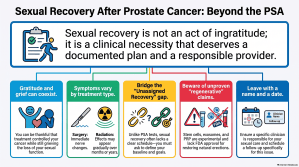
Sexual recovery after prostate cancer deserves a documented, individualized care plan. Recovery differs after surgery and radiation, requires clear goals and follow-up ownership, and should avoid unsupported regenerative-treatment claims.
F. Identify Who Will Help
I would like every patient who wants assistance to leave with a name. Someone should be clearly responsible for helping him take the next step.
The appropriate contact might be the treating urologist, a sexual-medicine clinician, or a coordinated survivorship team. Specific concerns may warrant other professionals, such as a pelvic-health physiotherapist or psychosexual therapist. [1,4]
Coordination should be explicit. Who makes the referral? Who checks that you were seen? Who reviews the outcome? These are reasonable questions, especially when more than one practice is involved.
G. Set a Specific Follow-Up Point
Before leaving, agree when the issue will be reviewed and what you will assess together. Put that date beside the next PSA appointment if that helps you remember it.
The interval should reflect the treatment and your circumstances. An open-ended instruction to return “if there is a problem” leaves too much unresolved when the problem already exists. A scheduled review creates a place to say that something helped, did not help, was uncomfortable, or no longer fits your priorities.

Erectile rehabilitation may support sexual activity during recovery, but it does not guarantee restoration of spontaneous erectile function. Evidence-based counseling and individualized follow-up remain essential.
If You Are a Partner
You may be relieved about the cancer outcome and uncertain about the distance that followed. It can be difficult to know whether to initiate affection, wait, ask questions, or avoid a subject that seems painful.
Try beginning with curiosity. One possible invitation is: “I miss feeling close to you. Could we talk about what feels comfortable now?”
Leave room for an answer you did not expect. Ask whether touch feels welcome and whether it comes with a sense of pressure. You do not have to settle the future of your sex life in one conversation.
Professional support can make these discussions easier. Sexual-health care may involve individual or couples counseling according to the patient’s wishes and circumstances. [1,12]
Partner involvement should always be the patient’s choice. Men who are single, dating, in different kinds of relationships, or private about their sexual lives deserve the same thoughtful attention. No one should have to bring a partner to justify seeking care.
What You Have Every Right to Ask For
What Recovery Can Include
Recovery can include intimacy, desire, satisfying orgasm, an erection achieved with assistance, easier communication, or less fear about what a changed body can do. Sexual recovery means different things to different men. [9,11]
Broadening the Definition
Broadening that definition must never become a way to dismiss a man’s desire for better erections. Equally, erectile performance is not a measure of personal worth. The patient should help decide what meaningful progress looks like.
Individual Differences in Recovery
Some men are comfortable with the changes after treatment and do not want further intervention. Others want help but have not found the words to ask. Neither should have someone else’s expectations imposed on him.
Honest Discussions Over Promises
I would rather offer an honest discussion of possibilities and limits than a promise of restoration that medicine cannot reliably keep.
Your Right to Bring It Up
You are allowed to bring this up, even if you did not mention it before. You do not need to prove that the problem is severe enough, or explain why it matters at your age. If it is affecting your life, it belongs in the conversation.
What Your Concerns Deserve
Your concerns deserve an evaluation and responsible options. The plan may involve treatment, support, a referral, or time with a clear point for review. It should leave you knowing the next step and who will help you take it.
Asking for Help
After prostate cancer treatment, sexual recovery deserves an explicit care plan—guided by the man’s priorities and followed through by his care team.
At your next appointment, you can ask:
“This part of my recovery still matters to me. Who can help me make a plan?”
Gratitude does not require silence. This part of your recovery deserves someone responsible for helping you through it.
Starting the Conversation
If you are experiencing unwanted sexual changes after prostate cancer treatment, begin with your treating oncologist or urologist. When a broader sexual-health evaluation is appropriate, a physician experienced in sexual medicine can help identify contributing factors, review responsible options, and coordinate with your cancer-care team.
This article is educational, does not constitute individual medical advice, and does not replace consultation with your treating clinicians.
About Dr. Ramesh Kumar
Dr. Ramesh Kumar is a physician with more than 30 years of experience in radiation oncology. His current work through LifeWellMD integrates sexual medicine, functional and longevity medicine, hormone evaluation, regenerative medicine, acupuncture, and physician-led individualized care.
Sources
[1] Carter J, et al. Interventions to Address Sexual Problems in People With Cancer: American Society of Clinical Oncology Clinical Practice Guideline Adaptation of Cancer Care Ontario Guideline. Journal of Clinical Oncology. Published online December 11, 2017; February 10, 2018;36(5):492–511. Guideline text.
[2] Li Y, et al. Sexual health distress and needs after radical prostatectomy: a scoping review. Sexual Medicine Reviews. January 7, 2026;14(1):qeaf077. Publication.
[3] Donovan JL, et al. Patient-Reported Outcomes 12 Years after Localized Prostate Cancer Treatment. NEJM Evidence. Published online March 11, 2023; April 2023;2(4):EVIDoa2300018. An erratum is linked in the record. PubMed.
[4] American Cancer Society. Surgery for Prostate Cancer. Revised July 27, 2026. Patient guidance.
[5] American Cancer Society. Radiation Therapy for Prostate Cancer. Revised July 30, 2026. Patient guidance.
[6] National Cancer Institute. Hormone Therapy for Prostate Cancer. Reviewed October 4, 2024. Fact sheet.
[7] European Association of Urology. EAU Guidelines on Sexual and Reproductive Health: Management of Erectile Dysfunction. Current online chapter, accessed September 5, 2026; individual chapter revision date not displayed. Guideline.
[8] National Cancer Institute. Sexual Health Issues in Men with Cancer. Reviewed December 29, 2022. Patient guidance.
[9] American Cancer Society. How Cancer Can Affect Ejaculation and Orgasm. Revised April 15, 2025. Patient guidance.
[10] European Association of Urology. EAU Guidelines on Sexual and Reproductive Health: Male Hypogonadism. Current online chapter, accessed September 5, 2026; individual chapter revision date not displayed. Guideline.
[11] American Cancer Society. How Cancer Can Affect Erections. Revised April 15, 2025. Patient guidance.
[12] Birimoğlu Okuyan C, Kerkez M, Bilgin A. Cancer Nursing Interventions for Sexual Function and Satisfaction in Men with Prostate Cancer: A Systematic Review and Meta-analysis. Seminars in Oncology Nursing. Published online February 27, 2026; April 2026;42(2):152169. PubMed.
[13] U.S. Food and Drug Administration. Important Patient and Consumer Information About Regenerative Medicine Therapies. June 3, 2021; accessed September 5, 2026. FDA notice.
[14] U.S. Food and Drug Administration. Consumer Alert on Regenerative Medicine Products Including Stem Cells and Exosomes. July 22, 2020; accessed September 5, 2026. FDA consumer alert.
