
The Medical-Grade P Shot: A Radiation Oncologist’s Guide to Erectile Restoration
Why Most P Shots Fail—And How a Board-Certified Physician Does It Differently
A 52-year-old executive sits across from me in our North Palm Beach clinic, visibly uncomfortable. “Doctor, I already got the P-Shot at another clinic six months ago. It did nothing. My wife thinks I’m making excuses. Is this just snake oil?”
I pull up his labs. Testosterone measures 247 ng/dL—clinically hypogonadal. Estradiol levels are sky-high. Vascular inflammation markers suggest arteries are coated in plaque.
“Sir,” I tell him, “the P-Shot isn’t snake oil. But injecting growth factors into a system with no hormonal fuel and blocked blood vessels is like planting seeds in concrete. You didn’t fail. The protocol failed you.”
This is the problem with commodified medicine. Across Florida—from West Palm Beach to Stuart to Port St. Lucie—men are paying $1,500 to $2,500 for “P-Shots” administered by physician assistants following cookie-cutter protocols. No comprehensive evaluation or hormone optimization. Just: “Sign here, drop your pants, you’re done in 20 minutes.”
I refuse to practice medicine that way.
As a Harvard Medical School-trained, Board-Certified Radiation Oncologist with over 30 years treating tissue damage at the cellular level, I understand what most “wellness clinics” don’t: Regeneration is not a transaction. It’s a biological process that requires the right environment, precise technique, and medical supervision.
This is your complete guide to the medical-grade P-Shot protocol we’ve developed at LifeWellMD for men throughout Palm Beach County and the Treasure Coast.
What Exactly Is the P Shot (Priapus Shot)?
The Priapus Shot—commonly called the P-Shot—is a regenerative medicine procedure that uses Platelet-Rich Plasma (PRP) extracted from your own blood to repair and rejuvenate penile tissue.
Here’s the science without the marketing fluff:
Your blood contains platelets—specialized cells that rush to sites of injury and release powerful growth factors. These include:
- Vascular Endothelial Growth Factor (VEGF): Stimulates new blood vessel formation
- Platelet-Derived Growth Factor (PDGF): Triggers tissue repair and cell proliferation
- Transforming Growth Factor Beta (TGF-β): Regulates cellular regeneration
- Epidermal Growth Factor (EGF): Repairs nerve tissue and epithelial cells
When we isolate and concentrate these platelets to 4-6 times baseline levels and inject them strategically into the penile tissue, we trigger a cascade of healing responses:
- Neovascularization: New capillaries form, improving blood flow to erectile tissue
- Collagen Remodeling: Damaged or fibrotic tissue is replaced with healthy, elastic collagen
- Nerve Regeneration: Sensation improves as nerve pathways repair
- Tissue Expansion: Healthier tissue leads to improved girth and, in many cases, functional length
The result? Stronger, more spontaneous erections. Improved sensitivity. In many cases, measurable increases in penile dimensions due to tissue health restoration—not “filler” or artificial enhancement.
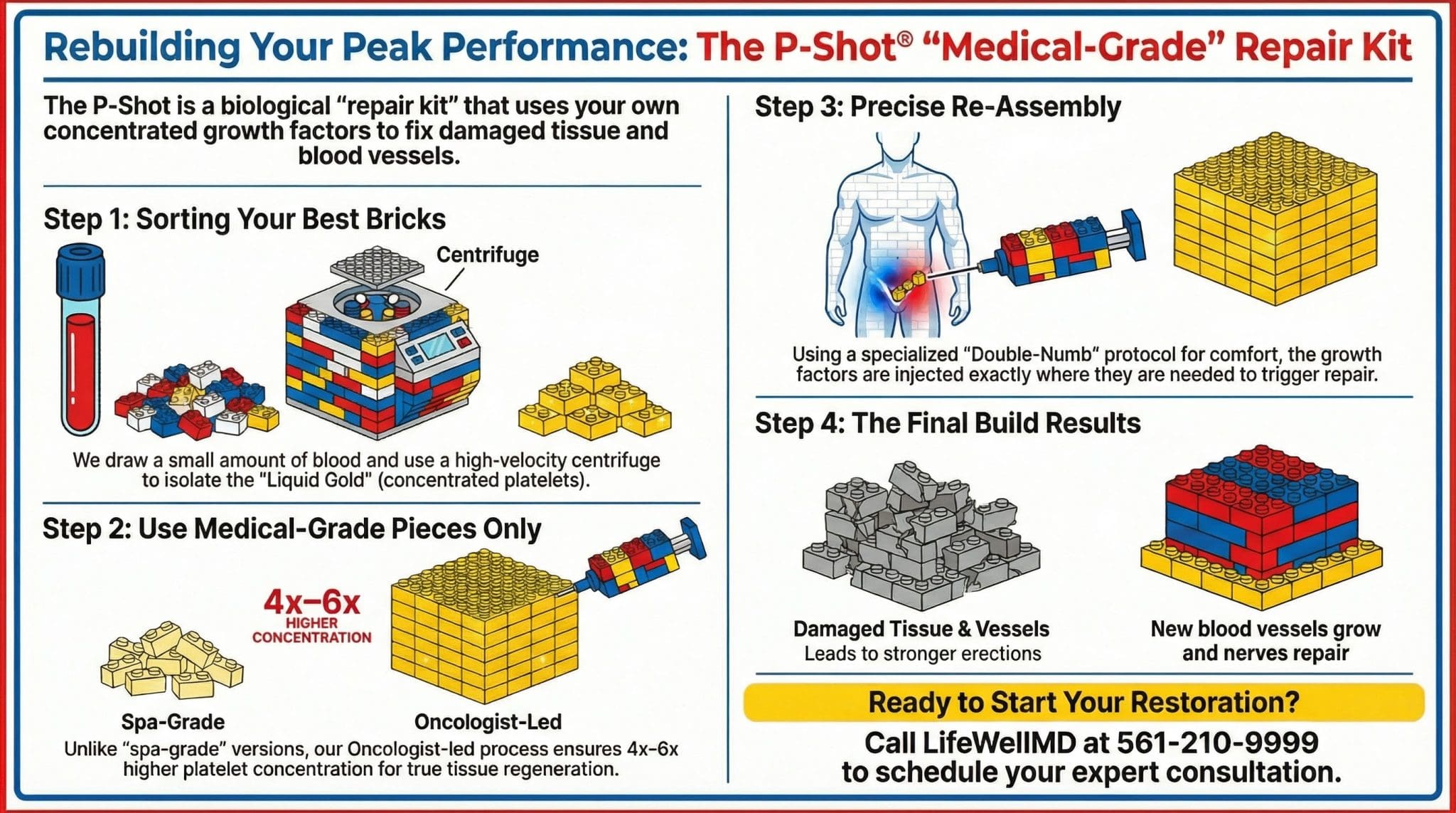
The Oncologist’s Advantage: Why Tissue Expertise Matters
“Why would I see a cancer doctor for erectile dysfunction?”
It’s a fair question. Here’s the answer:
Radiation Oncologists are the world’s foremost experts in radiation fibrosis—the scarring, hardening, and vascular damage that occurs in tissue after radiation exposure. I’ve spent three decades treating patients with severe tissue damage affecting the bladder, rectum, prostate, and yes—penile structures.
The penis is one of the most vascularly delicate organs in the male body. The Corpus Cavernosum—the twin erectile chambers—contain thousands of microscopic blood vessels that must rapidly expand to create an erection. When these vessels develop micro-plaque, scar tissue, or atherosclerotic changes, erectile function collapses.
My training gives me three distinct advantages:
1. Precision in PRP Preparation
Not all PRP is created equal. Many “med spas” and franchise wellness centers use basic centrifuge systems that produce PRP concentrations of only 2x baseline—barely therapeutic. Some use pre-packaged “PRP kits” that sit on shelves for months.
At LifeWellMD, I use hospital-grade centrifugation protocols that consistently achieve 4-6x platelet concentration. I personally verify the platelet count before injection. If the concentration isn’t therapeutic, I don’t inject it.
2. Anatomical Expertise
The penis contains the urethra, dorsal nerves, arteries, and the delicate tunica albuginea—the fibrous envelope surrounding the erectile chambers. Blind injection can cause urethral damage, nerve injury, or hematoma formation.
I use anatomical landmarks and, when indicated, ultrasound guidance to ensure precise delivery into the Corpus Cavernosum where platelets have maximum regenerative impact.
3. Safety and Sterility
I completed advanced training at Harvard Medical School in Safety, Quality, and Clinical Leadership. Every procedure follows strict sterile protocols. I personally handle your blood from draw to injection—it never leaves my sight. This isn’t delegated to a technician or assistant.
The “Synergy Protocol”: Why the P Shot Alone Often Isn’t Enough
This is where LifeWellMD diverges from every other clinic in Palm Beach or the Treasure Coast.
The P-Shot is a tool, not a cure. It’s one component of a comprehensive restoration strategy.
Think of it this way: If you tried to grow a garden in soil with no nutrients, in constant shade, with blocked irrigation—would planting premium seeds make a difference? Of course not.
Your body is the same. If your testosterone is crashed, your estradiol is elevated, your thyroid is sluggish, and your vascular system is clogged with plaque—injecting PRP is like planting seeds in a parking lot.
This is why I require a comprehensive medical evaluation before any P-Shot procedure.
Based on your labs, medical history, and physical examination, I often recommend a Multi-Modal Synergy Protocol that combines:
Shockwave Therapy + P-Shot Combination
Low-Intensity Shockwave Therapy (LiSWT) uses acoustic waves to create micro-trauma in penile tissue. This serves two purposes:
- Breaks up micro-plaque that blocks blood flow
- Triggers neovascularization—your body’s natural formation of new blood vessels
When we combine Shockwave with the P-Shot, we create what I call the “Till and Plant” effect:
- The Shockwave “tills the soil”—breaking up scar tissue and preparing the vascular bed
- The P-Shot “plants the seeds”—flooding the prepared tissue with concentrated growth factors
Clinical data shows this combination produces significantly better outcomes than either treatment alone, particularly for men with:
- Peyronie’s Disease (penile curvature)
- Post-prostatectomy ED
- Vascular-origin erectile dysfunction
- Diabetes-related ED
Hormone Optimization Protocol
Here’s what most clinics miss: Testosterone is the fuel for tissue regeneration.
PRP releases growth factors that signal your cells to repair. But if you don’t have adequate testosterone, thyroid hormone, and optimized estradiol levels, your cells can’t respond to those signals.
Before any regenerative procedure, I run a comprehensive hormone panel:
- Total and Free Testosterone
- Estradiol (E2)
- SHBG (Sex Hormone Binding Globulin)
- Thyroid Panel (TSH, Free T3, Free T4)
- DHT (Dihydrotestosterone)
- DHEA-S
- Complete Metabolic Panel
If your hormones are suboptimal, we optimize them first—then perform the P-Shot when your body is primed for maximum regeneration.
Vascular Health Assessment
Erectile dysfunction is often the first warning sign of cardiovascular disease. The penile arteries are smaller than coronary arteries—they show blockage earlier.
I assess your:
- Lipid panel (cholesterol, triglycerides)
- Inflammatory markers (hs-CRP, homocysteine)
- Insulin sensitivity
- Blood pressure and circulation
If indicated, I’ll recommend targeted supplements or medications to improve vascular health before proceeding with regenerative treatments.
The LifeWellMD P Shot Procedure: What to Expect at Our Palm Beach & Treasure Coast Clinics
We’ve optimized every step for comfort, privacy, and clinical precision.
Step 1: Comprehensive Consultation (30-45 minutes)
This isn’t a sales pitch. This is a medical evaluation.
I review your:
- Complete medical history
- Surgical history (especially prostate procedures)
- Current medications
- Sexual health history (onset of ED, severity, associated symptoms)
- Relationship context (partner status, sexual activity frequency)
For those seeking a more comprehensive or integrative approach to their healthcare, consider exploring holistic medical services at LifeWell M.D..
I perform a focused physical examination to assess:
- Penile anatomy and any abnormalities
- Presence of plaque or curvature (Peyronie’s)
- Testicular health
- Vascular circulation
If your case requires hormone optimization or additional vascular work first, I’ll tell you. I will not take your money for a procedure that won’t work in isolation.
Step 2: Blood Draw & PRP Processing (15 minutes)
We draw approximately 60cc of blood—similar to a standard lab draw.
Your blood is immediately processed in our medical-grade centrifuge using a dual-spin protocol:
- First spin: Separates red blood cells from plasma
- Second spin: Concentrates platelets to therapeutic levels (4-6x baseline)
I verify platelet concentration before proceeding. If the concentration isn’t adequate, I re-process or redraw.
Step 3: Advanced Anesthesia Protocol (20 minutes)
Pain control is critical—not just for comfort, but for results. Muscle tension and anxiety can cause vasoconstriction, reducing platelet uptake.
We use a “Triple-Defense” numbing protocol:
- High-potency compounded topical cream (not the weak over-the-counter stuff)—applied for 15-20 minutes.
- Penile nerve block using buffered lidocaine—targets the dorsal nerves. Only if needed.
- Local anesthetic injection at each injection site. Only if needed.
You will feel pressure. You should not feel pain. Most men report the procedure as far more comfortable than anticipated.
Step 4: Precision PRP Injection (10-15 minutes)
Using a very fine needle (30-gauge), I inject the concentrated PRP into strategic locations:
- Corpus Cavernosum (bilateral)—the main erectile chambers
- Glans penis (head)—for improved sensitivity
- Areas of fibrosis or curvature (if Peyronie’s is present)
- Base of penis—for structural support
I customize injection sites based on YOUR specific anatomy. This isn’t a template. Every man’s anatomy and pathology are different.
Step 5: Post-Injection Pump Protocol (Immediate)
I provide you with a medical-grade vacuum pump and specific instructions:
Immediately after injection, you’ll use the pump for 10 minutes to create gentle negative pressure. This serves two purposes:
- Distributes the PRP throughout the erectile tissue
- Prevents hematoma formation
You’ll continue pump therapy at home following our specific protocol to maximize tissue expansion and PRP integration.
Total appointment time: 90 minutes
Downtime: None. You can drive yourself home.
Sexual activity: Resume same day (though we recommend waiting 24 hours for maximum comfort)
Who Is the Ideal Candidate for the P Shot in Palm Beach & Treasure Coast?
The P-Shot is highly effective for specific patient profiles. It is less effective or inappropriate for others.
Ideal Candidates:
✓ Men with mild to moderate ED (can achieve erection with stimulation, but firmness or duration is inadequate)
✓ Peyronie’s Disease patients with curvature, plaque, or painful erections
✓ Prostate cancer survivors experiencing post-surgical or post-radiation ED
✓ Men seeking to reduce dependence on PDE5 inhibitors (Viagra, Cialis)
✓ Men experiencing decreased penile sensitivity or reduced pleasure
✓ Those seeking natural penile enhancement (girth and functional length improvement through tissue health)
Poor Candidates:
✗ Men with complete nerve damage (post-surgical nerve severance)
✗ Severe venous leak requiring surgical intervention
✗ Active infections or bleeding disorders
✗ Unrealistic expectations (expecting massive size increases or overnight cures)
During your consultation, I’ll give you an honest assessment. If the P-Shot isn’t right for you, I’ll recommend alternative therapies. My goal is results, not revenue.
Comprehensive FAQ: Your P-Shot Questions Answered
How much does the P-Shot cost in Palm Beach and Treasure Coast?
P-Shot pricing in Florida varies dramatically—from $1,200 at discount clinics to $2,500+ at luxury med spas.
Here’s what you need to know about price:
Low-cost providers often use inferior PRP kits, inadequate centrifugation, or delegate the procedure to physician assistants. You’re paying for an injection, not a medical protocol.
At LifeWellMD, our P-Shot includes:
- Comprehensive medical consultation with a Board-Certified physician
- Complete hormone and vascular assessment
- Medical-grade PRP processing with verified platelet concentration
- Physician-performed injection with advanced anesthesia
- Post-procedure vacuum pump and protocol
- 90-day follow-up and outcome tracking
Contact our office at 772-332-9975 for current package pricing. We offer combination protocols (Shockwave + P-Shot) at bundled rates for optimal results.
Is the P-Shot painful?
No. With our Triple-Defense anesthesia protocol (topical cream, nerve block, local injection), most men report feeling only mild pressure.
The most common comment: “I was terrified beforehand, but it was nothing like I expected.”
We take pain control seriously—not just for comfort, but because anxiety and muscle tension reduce treatment effectiveness.
How long does it take to see results from the P-Shot?
Results appear in phases:
- Week 1-2: Some men notice improved morning erections and increased sensitivity
- Week 3-4: Firmer erections with stimulation; improved spontaneous erections
- Week 6-12: Peak tissue regeneration; maximum improvement in firmness, duration, and girth
Tissue regeneration is a biological process, not a light switch. The growth factors stimulate your body to grow new blood vessels and repair tissue—this takes time.
Patience pays off. Most men report their best results at the 8-12 week mark.
How long do P-Shot results last?
Typically 12-18 months, but individual results vary based on:
- Age and overall health
- Hormonal status (optimized testosterone = longer results)
- Vascular health
- Lifestyle factors (smoking, diabetes control, exercise)
Many men choose annual “booster” treatments to maintain peak performance. Because the tissue regeneration is real—not just symptom masking—results tend to be cumulative over multiple treatments.
Can the P-Shot help with Peyronie’s Disease?
Yes. The P-Shot is one of the most promising non-surgical treatments for Peyronie’s Disease.
The growth factors in PRP help break down the fibrous plaque causing curvature while promoting healthy collagen remodeling. When combined with QuadMix vs. Trimix ED injection options:
- Shockwave therapy
- Vacuum pump therapy
- Specific stretching protocols
We’ve seen significant improvements in curvature reduction (often 20-40% improvement) and pain elimination.
Important: Peyronie’s treatment requires multiple sessions and adjunctive therapies. One P-Shot alone rarely resolves moderate-to-severe Peyronie’s.
Will the P-Shot increase penis size?
Here’s the honest answer: For information on personalized and holistic healthcare solutions, consider visiting LifeWell MD’s Stay Sharp page.
The P-Shot is not a “penis enlargement” procedure in the cosmetic surgery sense. We’re not injecting filler or performing surgical lengthening.
However, improved vascular health and tissue regeneration often result in:
- Girth increase: 0.5-1 inch in circumference (due to healthier, more engorged tissue)
- Functional length increase: 0.25-0.75 inches (due to improved blood flow and tissue elasticity)
These gains are tissue health improvements, not artificial enhancement. Healthier tissue expands more fully during erection.
If your primary goal is cosmetic enlargement rather than functional restoration, we’ll have an honest conversation about realistic expectations.
Can I combine the P-Shot with Testosterone Replacement Therapy?
Absolutely—and you should if you’re hypogonadal.
In fact, optimizing testosterone BEFORE the P-Shot significantly improves outcomes. Testosterone is required for tissue repair, protein synthesis, and cellular regeneration.
If your testosterone is low (below 500 ng/dL), I typically recommend:
- Begin Testosterone Replacement Therapy (TRT)
- Optimize levels to 700-1000 ng/dL range
- Perform P-Shot once hormones are stable (typically 6-8 weeks)
This creates the ideal metabolic environment for regeneration.
Is the P-Shot safe? What are the risks?
The P-Shot is extremely safe when performed by a qualified physician following proper protocols.
You’re using your own blood—there’s no risk of allergic reaction or rejection.
Potential side effects (rare):
- Temporary bruising or swelling (resolves in 2-4 days)
- Minor discomfort for 24-48 hours
- Temporary numbness (from anesthesia)
For more information about our team and philosophy, visit LifeWell M.D. in North Palm Beach, FL.
Serious complications (extremely rare with proper technique):
- Infection (prevented through strict sterile protocols)
- Hematoma (prevented through proper injection technique and post-procedure pumping)
- Urethral injury (prevented through anatomical precision)
I’ve performed hundreds of these procedures with zero serious complications. Technique and sterility matter.
Will my insurance cover the P-Shot?
No. The P-Shot is considered an elective regenerative procedure and is not covered by insurance.
LifeWellMD operates on a concierge, cash-based model. This allows us to spend the necessary time for comprehensive evaluation and treatment without insurance restrictions.
We accept all major credit cards and offer package pricing for combination protocols.
How does the P-Shot compare to Viagra or Cialis?
Different mechanisms, different goals:
PDE5 Inhibitors (Viagra/Cialis):
- Mechanism: Temporarily increase blood flow by relaxing smooth muscle
- Duration: 4-36 hours per dose
- Pros: Fast-acting, predictable, FDA-approved
- Cons: Treat symptoms only, don’t repair tissue; side effects (headaches, vision changes); require planning; lose effectiveness over time
P-Shot:
- Mechanism: Regenerates tissue, grows new blood vessels, repairs nerves
- Duration: 12-18 months of continuous improvement
- Pros: Addresses root cause; improves spontaneous erections; increases sensitivity; no pills needed
- Cons: Takes weeks to reach peak effect; requires upfront investment; not effective for all ED types
Many men use both: Pills for immediate reliability while the P-Shot regenerates tissue, then gradually reduce or eliminate pills as tissue health improves.
Can the P-Shot help after prostate cancer treatment?
Yes—this is one of my specialty areas.
As a Radiation Oncologist who has treated thousands of prostate cancer patients, I understand the devastating impact that prostatectomy (surgery) and radiation can have on erectile function.
Post-prostatectomy ED: Often caused by nerve damage and vascular injury. The P-Shot combined with early penile rehabilitation (pumping, medication) can significantly improve recovery—especially if started within the first 12 months after surgery.
Post-radiation ED: Radiation causes progressive vascular damage and fibrosis. The P-Shot’s regenerative properties can counter this process, improving blood flow and tissue health.
Best results: Early intervention (don’t wait years), combination with hormone optimization, and realistic expectations based on the extent of nerve damage.
What should I avoid after getting the P-Shot?
For 48 hours after treatment: If you are interested in learning about innovative options for men’s health, such as Botox for erectile dysfunction (ED), check out this comprehensive guide.
- Avoid strenuous exercise (light walking is fine)
- No blood thinners unless medically necessary (aspirin, ibuprofen)
- No alcohol (can increase bruising)
For 24 hours:
- Avoid sexual activity (to allow optimal PRP integration)
Ongoing:
- Follow the prescribed vacuum pump protocol (critical for results)
- Take any recommended supplements (L-arginine, L-citrulline if indicated)
- For more information on PRP therapy for tennis elbow, read our PRP for Tennis Elbow: Your Ultimate Guide.
Most restrictions are minimal. This is an outpatient procedure with essentially zero downtime.
Do you offer financing or payment plans?
We’re exploring financing options for comprehensive treatment packages. Contact our office at 772-332-9975 to discuss current options.
What we don’t do: pressure you into unnecessary treatments or lock you into contracts. You control your care plan.
Why Choose LifeWellMD for Your P-Shot in Palm Beach & Treasure Coast?
Because medicine is not a commodity.
You deserve more than a “package deal” administered by a physician assistant following a corporate protocol.
Here’s what sets LifeWellMD apart:
Board-Certified Physician Expertise
I’m a Harvard-trained, Board-Certified Radiation Oncologist with 30+ years of experience treating tissue damage at the cellular level.
Comprehensive Medical Approach
We don’t just “do the shot.” We evaluate your hormones, vascular health, and medical history to create a personalized regeneration protocol.
Concierge-Level Care
You’re not a number. Our Port St. Lucie and North Palm Beach clinics serve a select number of patients, ensuring you receive the time and attention your health deserves.
Evidence-Based Protocols
Every recommendation I make is grounded in peer-reviewed research and three decades of clinical experience—not marketing trends.
Patient-Centered Philosophy
My goal is maximum long-lasting results with minimum toxicity across all dimensions: medical, physical, emotional, time, and financial.
If the P-Shot isn’t suitable for you, I will explain why. When hormone optimization is necessary before treatment, I will recommend it. If combining therapies offers better results, I will advise accordingly.
Honesty over revenue. Every single time.
Take the Next Step: Schedule Your Confidential Consultation
Erectile dysfunction doesn’t have to be permanent. But improvement requires more than a quick injection—it requires a physician who understands tissue regeneration, hormone optimization, and vascular health.
Ready to explore whether the medical-grade P-Shot is right for you?
Contact LifeWellMD Today:
📞 Call: 772-332-9975
🌐 Visit: LifeWellMD.com
📍 Locations:\
Learn more about shockwave therapy for Peyronie’s Disease.
- Port St. Lucie: Serving the Treasure Coast
- North Palm Beach: Serving Palm Beach County
What Happens Next:
- Schedule your consultation (in-person or telemedicine available)
- Comprehensive medical evaluation with Dr. Kumar
- Personalized treatment plan based on your labs and goals
- Begin your restoration protocol with physician-led care
Telemedicine consultations available for men traveling from throughout Florida or those who prefer initial virtual assessment.
Don’t settle for cookie-cutter treatments. Don’t accept declining function as “just aging.”
You deserve physician-led, evidence-based regenerative medicine—not a commodity sold by a corporate wellness chain.
Call LifeWellMD at 561-210-9999 or visit LifeWellMD.com to begin your restoration journey.
Dr. Ramesh Kumar, MD, is a Harvard Medical School-trained, Board-Certified Radiation Oncologist with over 30 years of experience treating tissue damage and cellular regeneration. LifeWellMD provides integrative, physician-led care combining conventional medical expertise with advanced regenerative protocols. Serving Port St. Lucie, North Palm Beach, and the greater Palm Beach County and Treasure Coast regions.
Take the Next Step:
- Call LifeWellMD: 561-210-9999
- Telemedicine: Available for initial consultations if you are traveling from outside Florida.
Please check out his 120 five star reviews on Healthgrades and his 136 five star reviews at WebMD.
